Sunday, August 16, 2020

A Buffoon from Britain Playing Baseball

Time for another custom card.

First, here's the original:


1964 Topps Giant #9, Rocky Colavito


Rocky Colavito is certainly not the buffoon from Britain. But he is giant, because the card is a Topps Giant card.

As with many of the other custom cards I've done so far, the original version reminded me of a particular actor. It's something about that face and the slight squint. Is it making any connections for you?

Here are a few hints:

The actor is best known for a TV series in which his character's buffoonery around London is always on full display.

This character doesn't say much, and is often seen in a button-down, necktie, tweed blazer, and brown trousers.

In real life, the actor is quite the car enthusiast.

Guesses?

Here's the answer:
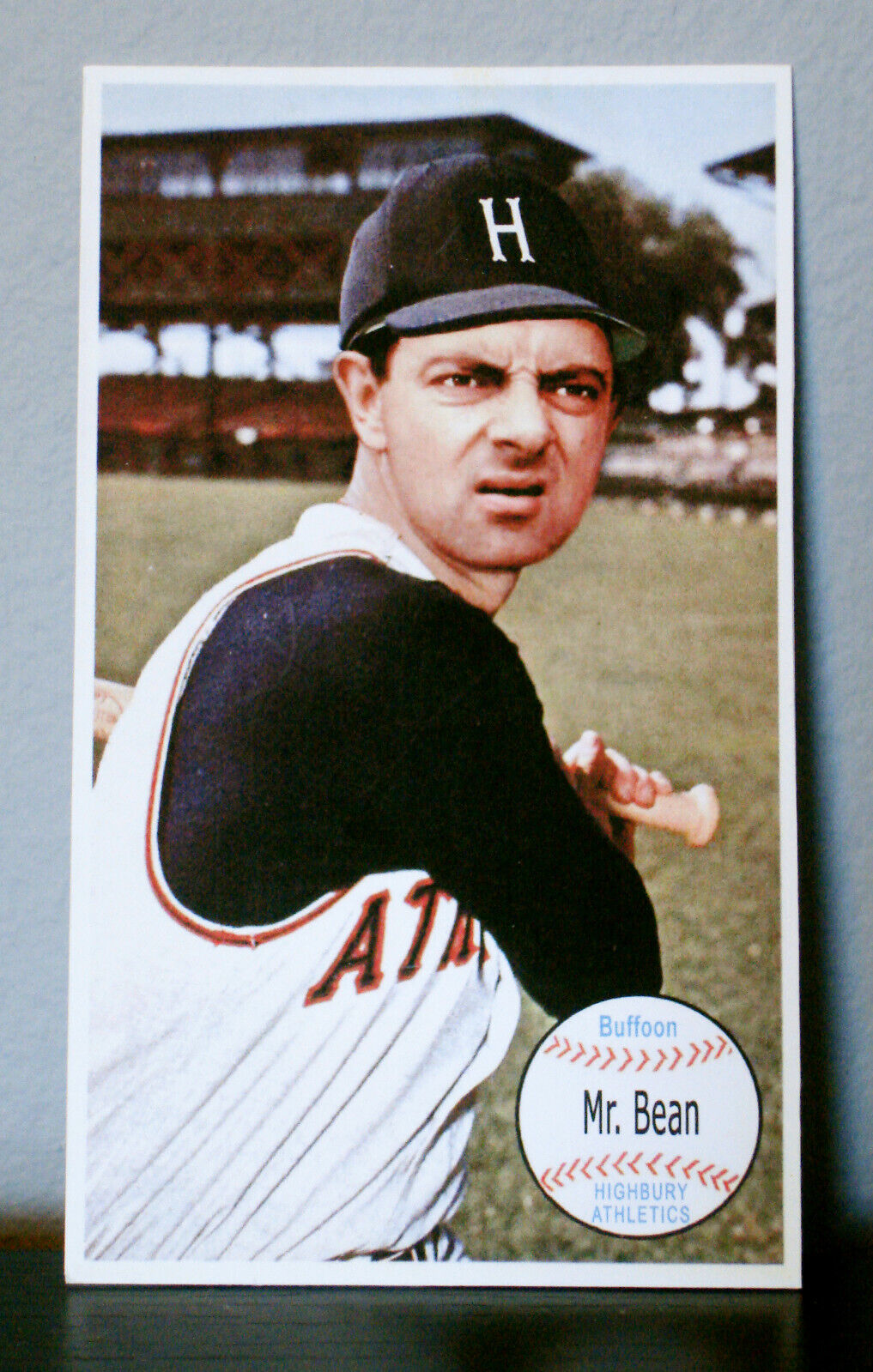


Mr. Bean!

He's looking more toward the camera than Colavito is, but if you scroll back and forth between the two cards a couple of times, I think you'll understand my line of thought.

The good follow-through that Bean is exhibiting here is not his own, of course. And the idea of Mr. Bean playing baseball in his own Mr. Bean way is pretty amusing, isn't it? That being the case, I've listed his position as "Buffoon." Also note that he plays for his hometown (albeit fictitious) team, the Highbury Athletics. I changed the letter on his baseball cap to match.

Now to the actor himself, Rowan Atkinson. Because he's such a car guy, I figured I'd create a few more customs featuring cars. The first three comprise a series of scenes from a particular episode of Mr. Bean. 

First, Bean has great difficulty finding a parking spot.


Then, Bean discovers a car of the same make, model, and color as his own parked in a spot marked "reserved". Astonished by the serendipity, he pulls his car off to the side, gets out, and:


He sneaks over to the twin car, opens the door, and begins pushing it out of the spot. After he enlists (i.e., tricks) two authority figures into helping him push the car farther and farther away from the reserved spot, Bean gets back into his own car, starts it up, shifts it into reverse, and backs it right into the same spot. And then:


As only Bean can, he exits the scene.

The card template is from the 1988 Maxx set. Horizontal cards in the original set didn't have captions along the bottom, and didn't proceed chronologically, but I think this adds a little humor (and British-ness) to the custom cards. And as you can imagine, it would be more fun to display them in a nine-pocket page this way.

Next is a vertical layout from the same 1988 Maxx set:


Yep, that's Rowan Atkinson himself, preparing for a road race. I think the red and blue in the border go rather well with the red lining in Mr. Atkinson's helmet.

Anyone out there a fan of Rowan Atkinson? Have a favorite episode of Mr. Bean?

Add a comment!


(Mr. Bean's car in that episode was a 1977 British Leyland Mini 1000 Mark IV.)

Sunday, August 9, 2020

From the Favorites Box: Samuel Morse, 1952 Topps Look 'N See #70

A series where I post some thoughts about favorite cards. Previous cards in the series are available here.


Here's a guy who is quite an important figure in world history. (But not for his beard, impressive as it may be.)

The letters and codes that appear to his left and right provide a clue.


I first learned of Morse Code as a young tot. Over the summers back then my mom, sister, and I would often go visit our grandparents in Queens, NY, and stay overnight. Grandpa in particular was a tinkerer. He had a workshop in the basement. He made art from pieces of wood. He played the violin and piano. In his younger days he served in the US Army as a mechanic and bugler. Seemed to know everything about everything, that guy.

One evening when things were winding down in the kitchen, Gramps brought out a small device made of plastic and metal, with a small battery attached by wires. He called it a telegraph. It probably looked something like this one:


He set it down on the kitchen table. Behind it he propped up a piece of cardboard that had a sheet of paper glued to the front. Printed on that paper was the alphabet, with a generous space between each letter. And next to each letter, various arrangements of dots and lines.

Well, Gramps proceeded to explain the telegraph to me, and how pressing down on that knob caused two pieces of metal underneath to touch and complete an electrical circuit, which allowed the telegraph to generate a distinct beeping sound. Once you let go of the knob, the lever would spring back up, the pieces of metal would separate, and the beep would stop. It was a combination of those beeps, sent by cables or radio wave, that allowed you to communicate over long distances. My primary-school brain soaked in everything as best it could. 

Essentially, there were only two beeps you needed to learn, a short one and a long one. He went over the first few letters of the alphabet with me, demonstrating the combinations of long and short beeps that made up each letter, and then showed me how to string the letters together with codes like "S.O.S." (dot-dot-dot / line, line, line / dot-dot-dot)

I gave it a try. Seeing my enthusiasm, Gramps left me to it and soon went up to bed, along with the rest of the family. But there I remained, sitting in the kitchen, beeping the alphabet away, a small lamp on the table the only light on in the house.

At some point, someone must have come back downstairs and told me "okay, that's enough for one night". But I don't exactly remember who it was, or how long they allowed me to keep clicking away on that lever. 

Here's more information on the telegraph and Morse Code from the back of the card.


Note the secret message you're asked to find at the bottom.

Last year I shared the first card I picked up from this 1952 Topps Look 'N See set, featuring one of my all-time favorite authors, Jules Verne. I tried placing a piece of red cellophane on top of that one to decode the message, but it just wasn't coming out clearly enough, possibly from a fading or aging of the blue-ish ink used for the secret image. (If you look closely at the card back above, you can see something of an image behind the text.)

Eventually I was able to decode it by scanning the card, opening it in Photoshop, and placing a red-colored transparent layer on top, so I wanted to try again here.

The question we have to answer this time: 

What was the first message sent by wireless?  

(Get ready before you scroll down, it's rather bright)


*
*
*
*
*
*
*
*
*
*
*
*
*


What hath God wrought?

On May 24, 1844, Samuel Morse, who was at the US Capitol, and Alfred Vail, his colleague at the other end of the line at a railroad station in Baltimore, wanted to share a message that would capture the awe and amazement of the onlookers that day, and after that, the world.

It's difficult to make out details of the telegraph itself in the image, but you can see an illustrated Morse tapping away at a device. Regardless, I know I would have enjoyed decoding this card if I'd been a kid in 1952.

And for the great memories of Grandpa, one of my best friends in the world, 1952 Topps Look 'N See #70 has a place in my box of favorite cards.


Bonus Feature: MORSE CODE CHALLENGE

Take a minute and translate the following.

-. .. -.-. . / -... . .- .-. -.. / ... .- -- ..- . .-.. -.-.--

Sunday, August 2, 2020

A One-Question Baseball Quiz

Here it is:

Does the following list contain (A) the names of real professional baseball players or (B) the names of fictional baseball players that appear in a vintage video game?

Kyle Hypes
Tommy Toms
Horace Speed 
Rocky Bridges
Johnnie LeMaster

(Scroll down for the answer)


         *

         *

         * 

         * 

         * 

         * 

         *

         * 

         * 

         *


Answer: A

That's right. These are all names of actual baseball players. I suspect that a bunch of you were familiar with at least one or two after seeing them somewhere in your baseball card collections. But if you're one of the readers who finds the answer a bit hard to believe, you'll find this next piece of information even more so.

In 1976 these players were all on the same minor league team: The Phoenix Giants. And there's a set of cards to prove it, released by a company called Cramer Sports Promotions. Here's the card for each player listed above, along with some career stats and information.


Kyle Hypes did not go on to pitch in the majors, but had good success through his minor-league career, making it as high as AAA. He finished with a career 66-59 record, 4.53 ERA, 31 complete games, and 626 strikeouts. In 1971 single-A ball, he put up pretty good batting numbers, too: 20 hits in 67 at-bats (.299 avg), 2 doubles, and 10 RBI. 


Tommy Toms did not have much of a big-league record, putting in a handful of middle relief work across three seasons (1975, '76, and '77). He had a winning record through his 6-year minor-league career (31-29, 3.08 ERA, 357 strikeouts).


Horace Speed played one season with the big-league Giants and two with the Cleveland Indians. Overall, he put up a .207 average with 28 hits, 6 RBI, and 4 stolen bases. Good minor-league totals across 11 years (958 hits, 165 2B, 55 3B, 127 HR, 568 RBI, 141 SB, .259 avg)


Rocky Bridges was a handy utility infielder in his playing days (11-year career with the Brooklyn Dodgers, Reds, Senators, Tigers, Indians, Cardinals, and Angels). His career as a minor-league manager was twice as long. He coached for the minor-league affiliates of the Angels, Giants, Padres, and Pirates, and just about pulled off a .500 record (1300-1358).


Johnnie LeMaster had a serviceable and lengthy major-league career from 1975 through 1985, mostly with the Giants. His totals: 709 H, 109 2B, 19 3B, 22 HR, 229 RBI, 94 SB, .222 avg.


Although there are no MLB all-stars in that group, you do have some good-looking cardboard, don't you think? And the team did have some players who would make noise in the majors:


Jack Clark was an all-star and Silver Slugger on multiple occasions over his 18 seasons in the big leagues. He had a career year with the Cardinals in 1987, ripping 35 home runs and leading the National League in on-base percentage (.459) and slugging percentage (.597). He'd top that by leading all of Major League Baseball in OPS (1.055) and walks (136). And speaking of walks, he set a record that year by drawing a walk in 16 consecutive games.

Bob Knepper had a nifty 15-year career with the Giants and Astros (and perhaps a niftier Fu Manchu?). The two-time all-star finished with a record of 146-155, an ERA of 3.68, 78 complete games, 30 shutouts, and 1,473 strikeouts.

Larry Herndon played for the Giants and Tigers across his 14-year career. The 1984 World Series champ might have put up his best personal stats the year before, setting career highs in hits (182), doubles (28), and RBI (92), and finishing the season with a .302 batting average.


Back to the cards, though. I'd say the design is excellent for a minor league set. The photography is pretty cool, as well. I like those low-angle shots. They make some of the players look 8 feet tall. 

Now here's an example of a card back. 


"Hobby: Playing Pool"

That's fantastic. Other players listed hobbies such as music and cars, collecting coins, and playing bridge. It's just more evidence that this is a fun, well-executed little set of cards.

If you were on the 1976 Phoenix Giants team and were given a card in this set, what would you list as your hobby? (Aside from collecting cards, of course.)

List your answers in the comment section. And thanks for reading, as always.

Sunday, July 26, 2020

The 1982-83 O-Pee-Chee Dating Game (Episode 11)


Welcome back to The 1982-83 O-Pee-Chee Dating Game, where we'll randomly select three eligible bachelors from the set and you, the reader, will choose which one wins that date with a special lady. How do we know they're bachelors? Why, it says so right on the back of their hockey cards, that's how!

Previous episodes are available here.

The big winner of episode 10 was Glenn Anderson.

Now, let's start the 11th round and introduce the bachelors chosen by the randomizer! [APPLAUSE]

Bachelor number 1: Left wing from the New York Rangers, Don Maloney
Bachelor number 2: Left wing from the St. Louis Blues, Jorgen Pettersson
Bachelor number 3: Center from the New York Rangers, Mark Pavelich


For the first time we've got two players from the same team vying for a date with a special lady!

Let's find out about all three gents from the back of their cards.


Who wins this round?

Bachelor number 1: Canadian man Don Maloney, who's ever so close to reaching the 30-goal mark for a season.

Bachelor number 2: Swedish man Jorgen Pettersson, who plays golf and tennis in the summer sun.

Bachelor number 3: American man Mark Pavelich, a 1980 Miracle Olympian and fishing enthusiast.


Sunday, July 19, 2020

No Sleep Till Custom

I'm going to guess that Fuji over at the Chronicles knew what was coming as soon as he saw the title of this post.


If the Beastie Boys were Major League baseball players, their rookie season would have fallen around 1981 or 1982. And if their opening campaign turned out well, Topps would have likely given them a Future Stars card like the 1982 version you see above.

I stayed true to the original design, using headshots of the young trio and listing them in alphabetical order. I also borrowed some spring training backgrounds from a couple of original Future Stars cards. For the fielding position, I used each member's stage name. (Although it's important to note that all three played musical instruments as well.)

As a 1980s kid growing up in lower New York, it seemed hard to avoid the Beastie Boys. Their names would come up in school, on the radio, and in the news. Early on I remember thinking they were just a novelty; three city kids trying a little too hard to be bad boys. Kind of a spoof. But they kept going, developed their talents, created a style and sound all their own, starred in some rather creative music videos, and my goodness did they ever build up a huge following and sell a lot of records. They also inspired quite a number of the next generation's musicians and performers.

If you want to continue with the baseball card theme, by the time the 1990s arrived you would have certainly found Mike D, Ad-Rock, and MCA on all-star cards and league-leader cards in addition to their base cards.

They even linked some lyrics to baseball, saying "I got more hits than Sadaharu Oh" in the song Hey Ladies.

That's a fun line, isn't it? 

It's so fun, in fact, that it inspired me to cook up another custom card.


The highlight card template is from the 1984 Topps baseball set. The song Hey Ladies wouldn't be released for another five years, and because of that the card doesn't make sense chronologically. But the opportunity was just too perfect. Three image frames, three Beastie Boys. And in the empty space, a blue text box to describe the highlight. So I went for it, and just switched the date on the front to 1989.

This was a fun mash-up, for sure. Thanks for reading, as always. 


Sunday, July 12, 2020

The Only Kid at the Art Auction?

I'm going to paraphrase a conversation between my dad and I that took place at some point during the summer of 1991.

Dad: Want to come to an art auction with me tonight?

Me: Umm. I don't know.

Dad: Pat Lafontaine will be there, signing autogr...

Me: I'll go! 

1991 puts me in middle school. Safe to say I wouldn't have wanted much to do with an art auction back then—especially if the event was being held at a random car dealership in the middle of my summer vacation, as was the case here.

It's not like my dad and stepmom were art collectors, either. But I don't know. It's certainly possible that they were looking for a new painting for the walls. Or maybe dad knew that I'd recently gotten into the sport of hockey and that Pat LaFontaine was the biggest hockey name on Long Island, and the whole "wanting to go to an art auction" thing was just a case of dad doing something cool for his boy. 

In any case, I'd already gotten busy flipping through my hockey cards and decided to take out the most recent LaFontaine printing from Upper Deck:


1990-91 Upper Deck #246, Pat LaFontaine

 
Nifty-looking card. And that, I told myself, is what I'd ask Mr. LaFontaine to sign. 

Soon we'd arrive at the dealership. A decent crowd had gathered, but it wasn't exactly a throng of hobnobbing artsy folk. (I don't think the auction was a widely advertised thing.) All the cars had been cleared out of the main showroom and rows of folding chairs had been arranged in front of an auctioneer's podium. Dad and I found two seats and waited for the games to begin.

Well, they began. There were lots of generic oil paintings. One after the other. I wasn't paying a whole lot of attention, but there must have been a few bidding wars, which I can only assume I enjoyed at least a little bit. (Dad bid on a couple of different items, but wasn't the high bidder on either occasion.)

They didn't have the air conditioning turned on, so it was certainly stuffy in there. I do remember that. And although the auction probably didn't last more than and hour or two, it sure seemed like forever to me.

Finally, the last painting came off the block, and we got on the line for autographs.

When we approached the table and I handed Mr. LaFontaine the Upper Deck card, he looked at me with a little smirk, as if he wanted to sarcastically ask, 

"So, you like art auctions, do you?"

Or maybe he appreciated the fact that a kid would sit through an entire auction just to get an autograph from a hockey player.

Regardless, he was very cordial, said hello with that smile still on his face, and happily signed the card even though I think he was mostly signing photographs that the dealership (or the Islanders) had provided. Here's the card, with autograph:


Dad and I gave our thanks and commended him on a great season, and then we scooted from the line to allow the next fan to receive an autograph.

As it turned out, just a couple of months later Mr. LaFontaine would be moving up to Buffalo in that big trade involving Pierre Turgeon. (The full trade was LaFontaine, Randy Wood, Randy Hillier, and a 4th-round draft pick for Turgeon, Benoit Hogue, Uwe Krupp, and Dave McLlwain.)

It worked out pretty well for both teams. Turgeon had some monster years on the Island, and LaFontaine made absolute magic with Alexander Mogilny in Buffalo. Have a look at these numbers from the 1992-93 season, for example:

Turgeon: 83 GP, 58 G, 74 A, 132 PTS, 24 PP Goals, Lady Byng trophy, 5th in NHL scoring

LaFontaine: 84 GP, 53 G, 95 A, 148 PTS, 20 PP Goals, 2nd in NHL scoring

Still, Patty was really missed by the fans on the Island.

I'm glad I had the chance to briefly meet him before the trade. Even happier to still have this card, in addition to the memories. Was the card the best piece of art in the auction that night? The 1991 version of me would probably say yes.

You readers and fellow collectors must have a good childhood autograph story or two. Feel free to share in the comment section.

And thanks for reading!

Sunday, July 5, 2020

Completed Set: 1988 Topps UK Baseball Minis

Here's a set that I put together solely through trades. That might sound impressive (or foolish), but the entire set consists of just 88 cards, and I received about half of them from a single trade, so it really didn't take immense effort to complete.

The small number of cards isn't the only thing that makes this set unique, however. Here are some other details:

  • It was produced and marketed in the United Kingdom.
  • The cards were sold in a box as a complete set, and also in individual packs (5 cards, 1 stick of bubble gum).
  • Here in North America they're referred to as "Topps UK Minis", but over in the UK they were sold as "Topps American Baseball".
  • The cards are in fact mini. They measure 2-1/8 inches by 3 inches. 

 Here are some of my favorite cards in the set:


Good, simple design. The yellow color bar across the bottom is eye catching, and highlights the player name and position well. Using each team's official wordmark across the top instead of the same standard font for all teams is a really nice touch, too—especially for the UK market.


Here are three top-notch hitters who've just connected. Tony Gwynn almost resembles a cricket batsman with the way he's following through there. As for Rickey, he didn't hold back, did he?


The photography in this set isn't spectacular, but for Topps in the year 1988 I'd say it was a little bit above average. And that does have some importance, as surely some of the UK kids opening these packs didn't know a whole lot about the sport and its stars.


At the time, there were 26 teams in Major League Baseball. All 26 were represented in this set. That's another check-mark for the designers. You'll find more good design on the card backs.


I'm impressed with the amount of information here. The player name really stands out. Same goes for the card number, which is surrounded by stars—a nice tie-in to the star design on the front. Next you've got a simple one-season stat line, with career numbers too. That's fine with me, considering the market Topps was going after with this set. Besides, that leaves more room for what we find underneath. 


There's a baseball graphic on the right, with the player's facsimile signature and bio-type information printed on top (notice the weight listed in stone!). On the left, you've got a classic Topps cartoon that shares some information about the player. Below that, perhaps the most interesting aspect of the card.


Topps really nailed it with the Talkin' Baseball box. Each box describes a baseball rule or action which would seem far too rudimentary for those of us who grew up watching baseball here in North America, but served a great purpose for the market in the UK. Just think about how helpful a Talkin' Cricket box would have been if you were opening a pack of "Topps UK Cricket" cards when you were a kid.


Continuing with the fronts now, we've got two legendary Orioles surrounding Kirby in the Homer Dome. I have a feeling some of the Twins and Cardinals photos used in this set were taken during the 1987 World Series. The catcher and player (or bat boy) in the background of Kirby Puckett's card here seem like Cardinals.


Here's Nolan in that classic Astros jersey, Ryno with a mustache(!), and Ruben with a strong swing. On the back of Sandberg's card, the American spelling of "favorite" is used, not the British "favourite". I wonder if that was just an oversight. Other copy is a little bit more British. For instance, the cartoon on Dave Stewart's card mentions how he signed his first professional "pact" as a catcher. We'd have used the word "contract" instead.


You can see that the set features a nice combination of headshots, players in moments between game action, and action shots. It also includes a good amount of pitchers (20).


Have a look at the red, white, and blue bunting in the background of Frank Viola's card here. Another World Series shot? In the middle, Robin Yount swings for the fences. And on the right, the final card of the set, which is a checklist. Another nice touch.

I'm happy to have completed this one. There are 9-pocket pages designed for smaller cards, and I'm thinking this set might look nice displayed in a binder. I'd only need 10 pages, after all.

Have you ever collected trading cards that feature a sport that's more popular outside of North America? Did the cards themselves help you learn about the sport?

Share in the comment section, and thanks for reading!