Showing posts with label From the Favorites Box. Show all posts

Sunday, January 16, 2022

From the Favorites Box: Andre the Giant, 1990 Classic WWF #130

A series where I post some thoughts about favorite cards. Previous cards in the series are available here.
 
 
Quick exercise in imagination:

Picture yourself attending one of those 1970s wrestling exhibitions. You know, the kind where the local gym or civic center puts on a challenge: "STEP INTO THE RING AND LAST FIVE MINUTES AGAINST [insert wrestler of minor fame here] AND WIN 100 DOLLARS!"

Now imagine on this particular night you're feeling some bravado. A little spunk. (After all, you've been working out more than usual, and earlier this week your co-worker said "OUCH!" when you shook his hand.) 
 
And when no one in the audience accepts the $100 challenge issued by the master of ceremoniesnot even after some major-league cajoling—you walk right up to the ring and hop in there.
 
The raucous, spirited cheer from the crowd only emboldens you.
 
"WE'VE GOT A CHALLENGER!", the emcee yells out.
 
You turn left and right and put a hand up to acknowledge the audience. Then you strut around your corner while the emcee takes the microphone again and introduces the wrestler of minor fame that you'll be going up against. It's a guy who locals have dubbed "Andre the Giant".
 
You turn to the opposite corner and watch, stunned, as the behemoth lifts one of his size-24 feet over the middle rope and into the ring, and stares you down like so:


Suddenly the crowd is no longer on your side.
 
Is your first reaction to take a step back and reach for the ropes so you can get out of there? 

I'm pretty sure mine would be. And that would finish my exercise in imagination.

I'll let you finish your version of the story however you'd like. But that look on The Giant's face? That does it all for me. Why would he even need to trash talk? Or say anything? It's a special ability that not everyone has—not even every wrestler.
 
And simply for that special ability to intimidate without a word, like Andre is doing on his trading card up there, 1990 Classic WWF #130 has a spot in my box of favorite cards.

Sunday, October 3, 2021

From the Favorites Box: Glenn Healy, 1991-92 O-Pee-Chee #368

A series where I post some thoughts about favorite cards. Previous cards in the series are available here.

Here's Glenn Healy, minding the net at Nassau Coliseum.


The old Coliseum, the classic home white uniforms, the advertisement on the boards behind him, it all reminds me of a Glenn Healy story from a game I attended back then—probably around the same year this card was released. 
 
Toward the end of pre-game warmups, Mr. Healy was still on the ice and noticed a few kids standing 15 or 20 rows back from the glass, behind his net. No one else was in that section of seats. (The Islanders weren't very good at the time, and weren't drawing huge crowds during pre-game warmups, especially on a weeknight as it was.) It became clear to me that he was trying to figure out a way to get a puck or two up there so the kids could go home with a souvenir. But how? 

Well, he got the attention of a couple of his players and pointed them toward the kids. Then he moved to the side of the goal, tapped the blade of his goalie stick on the ice, and tilted it back, effectively producing a ramp. (Can you see where this is going?) 

The players picked up on it. They began deliberately shooting pucks hard and along the ice, right toward Healy's stick-ramp.

Unfortunately for Healy, he'd angled his stick perfectly wrong. Instead of going up and over the glass, the first shot went straight into the top of the goal!

He threw his head back as if he were saying "D'oh!"

It was a funny moment. And as I look back now, it's impressive. Think about it. There was Glenn Healy, professional NHL goaltender, having fun like a kid—during warmups of an NHL game. 

When most players were busy getting their game faces on, Healy was busy trying to get a hockey puck to a few kids in the stands. Now it could be that he wasn't the starting goaltender that evening, and that's why he was goofing around a little bit. I don't know. But in any case, the moment stuck with me.

And if you know anything about Mr. Healy, it will all make perfect sense. 

He was quite a lighthearted guy during his playing career (as evidenced by a little TV comedy spot he'd occasionally do with teammate Patrick Flatley called The Heals and Flats Show. In this particular segment they discuss the differences between the NFL and the CFL). 

Not surprisingly, after his playing career ended, Healy continued to amuse hockey fans as a color commentator and analyst for various Canadian television networks. Currently he's the President and Executive Director of the NHL Alumni Association, and despite the lofty job title, I'm sure he still keeps everyone laughing.

Here are his career numbers across 15 seasons: 437 GP, 166 W, 190 L, 47 T, 13 SHO, 3.37 GAA, .887 SV%

Although he didn't spend much of that time as his team's outright number-one goalie, Healy had some pretty good individual seasons, winning as many as 25 games with the Kings in 1988-89 and 22 games with the Islanders in 1992-93. He also played a big part in taking the Isles to the Conference Finals that season, dethroning the two-time defending champion Pittsburgh Penguins along the way. 

The following year he was traded to the Rangers, just in time to provide solid backup to Mike Richter across 29 games of the regular season. He also helped the team hoist the Stanley Cup that year, appearing in parts of 2 playoff games and posting a robust .941 save percentage (16 saves on 17 shots) along with a minuscule 0.89 goals-against average.

I'm sure he played a big part in keeping his teammates loose during those intense Stanley Cup games, too.

And for reminding us that it is indeed possible to have a little fun despite the pressure of playing a professional sport—or perhaps because of the pressure—1991-92 O-Pee-Chee #368 has a spot in my box of favorite cards.

Here's to the new hockey season.

Sunday, August 29, 2021

From the Favorites Box: Robin Yount, 1978 Topps #173

A series where I post some thoughts about favorite cards. Previous cards in the series are available here.
 
Quick thought exercise:
 
You're on a baseball field, in uniform, when a photographer walks up to you and asks if they can take your photo for a baseball card.
 
What's the first pose you think about taking?


For quite a few of you, I'd bet it looks like Robin Yount here.
 
It’s just a timeless image. And lately I've been wondering why. 
 
I think some of it has to do with the anticipation and potential energy that's so prevalent in the game of baseball. Mr. Yount is in a good position there. His energy is stored up and ready to go. The pitcher is standing on the mound 60 feet away, and all he needs to do is throw that ball toward home plate. Everyone in the entire stadium is hanging on the moment. And so the picture you see above really is worth a thousand baseball words, isn't it?
 
Maybe another part of it has something to do with the warrior spirit—getting into that ready position to deal a solid blow to your enemy (in this case, a baseball that's been flung in your direction at a high speed.) 
 
There's also something to be said about portraiture. Consider other vintage sports cards. Football quarterbacks pose with football in hand, drawn back, with their other arm stretched forward to help show you their aim is true. Basketball players pose holding the ball in front of them, ready to pass it right out of the frame and into your room. Hockey players pose with two hands on the stick, blade solidly on the ice in front of them, ready for the face-off.

But I'm not sure any of those other sports poses have had quite the longevity of baseball poses like the one you see on the card above.

I think it's a real possibility that in the early 1960s, a young Robin Yount saw a baseball card depicting a professional ballplayer in that batting pose. Then Yount, in turn, took the same pose as a young professional on this 1978 card. And when a little kid pulled this Robin Yount card from a pack in 1978, he was inspired enough to take the very same pose when he became a young professional in the mid-1990s. And so on. And so on. All the way up to this day. I've even gotten in front of a mirror holding a bat to see how I'd fit into the continuity of it all. I'm sure some of you readers and baseball fans have done the same. There's something I like about that.
 
And for beautifully proving that some things in baseball never change (and never should), 1978 Topps #173 has a spot in my box of favorite cards.
 
 
PS: Stay tuned for some big news here next Sunday. Big, fun news.

Sunday, December 6, 2020

From the Favorites Box: Rich Gossage, 1979 Topps #225

A series where I post some thoughts about favorite cards. Previous cards in the series are available here. 

Have a look the delivery captured on this card:


The amount of effort that's just been exerted is outrageous. It's all arms and legs moving left, right, up, down, and off balance. If the scene were in a cartoon, you’d be hearing the sound of screeching tires and pots and pans clanking around.

But the guy probably just hurled a baseball right at the catcher’s target—and close to 100 miles per hour, too. Figure that one out.

What doesn't take figuring out is how that intense delivery produced success for Mr. Gossage. If the image above is a snapshot of game action from 1978—the year before this card was printed—then "Goose" was on his way to posting 122 strikeouts in 134.1 relief innings pitched to go along with a nifty 2.01 ERA and a league-leading 27 saves.

He'd also help the Yankees take their second consecutive World Series title against the Dodgers that fall, pitching six shutout innings across three games, striking out four batters along the way.

And although that was the only World Series victory he'd experience, his pitching success would go on for years and years (22 seasons, in fact). Goose made nine all-star teams from 1975 to 1985, totaled more career strikeouts than hits allowed, and finished with more than 300 saves. And if Major League Baseball kept stats for the most intense delivery and total number of batters intimidated, Mr. Gossage would be pretty high up on those lists, too. Not sure how I'd feel stepping into the box in the bottom of the ninth and seeing that guy winding up 60 feet away from me.

For rearing back and throwing it as hard as you can, for as long as you can, in any way you can, 1979 Topps #225 has a place in my box of favorite cards.

Sunday, November 1, 2020

From the Favorites Box: Charlie Moore, 1986 Topps #137

A series where I post some thoughts about favorite cards. Previous cards in the series are available here. 

Here's an example of excellent timing:


On that day at the ballpark, a Topps photographer had the camera aimed at Charlie Moore and clicked the shutter at just the right moment. 

The veteran catcher is about to unleash a throw toward what looks like third base. His cage is already off (note the soft baseball capold school). Dirt is being kicked up around home plate. The runner must be scurrying to the bag in a panic, knowing a laser beam will be headed toward the third baseman's open glove in an instant.

And for those of you who like a classic powder-blue uniform, you've got that here as well.

As for the man on the card, Charlie Moore was a utility guy of sorts: catcher, outfield, designated hitter. Over his 15-year career he even played a few innings at second and third base, with a perfect 1.000 fielding percentage (three chances, three assists).

His best year came in 1983, when playing mostly the outfield he set highs in games played (151), plate appearances (605), and a whole bunch of offensive categories: 150 H, 27 2B, 49 RBI, 11 SB, 55 BB.

But since this particular card features him as a catcher in action, here's one more stat: For his career, Mr. Moore would throw out a total of 272 base runners at a clip of 36%. That total of 272 puts him ahead of names like Todd Hundley, Ron Hassey, and Ozzie Virgil. The percentage puts him ahead of names like Brad Ausmus, Mike Scioscia, and Tony Pena.

Let's get back to that card now. Look at the image once again, but try this:

Take the baseball out of his right hand and replace it with a spear. Take the mitt off his left hand and replace it with a shield. 

You'd practically be in ancient Greece. 

And there you'd surely see Charlie Moore's pose painted on pottery and set in sculpture.

It's something, isn't it? The field of battle might be different, but Moore is a still a warrior on that card. And if you're the kind of sports fan who keeps a personal Mount Olympus of athletes, then Charlie Moore could be an Olympian in the original sense of the word.

For a timeless pose that reminds us of the feeling of excitement that sport has brought—and will always continue to bring—1986 Topps #137 has a spot in my box of favorite cards.

Sunday, September 6, 2020

From the Favorites Box: Colts Leaders, 1986 Topps #314

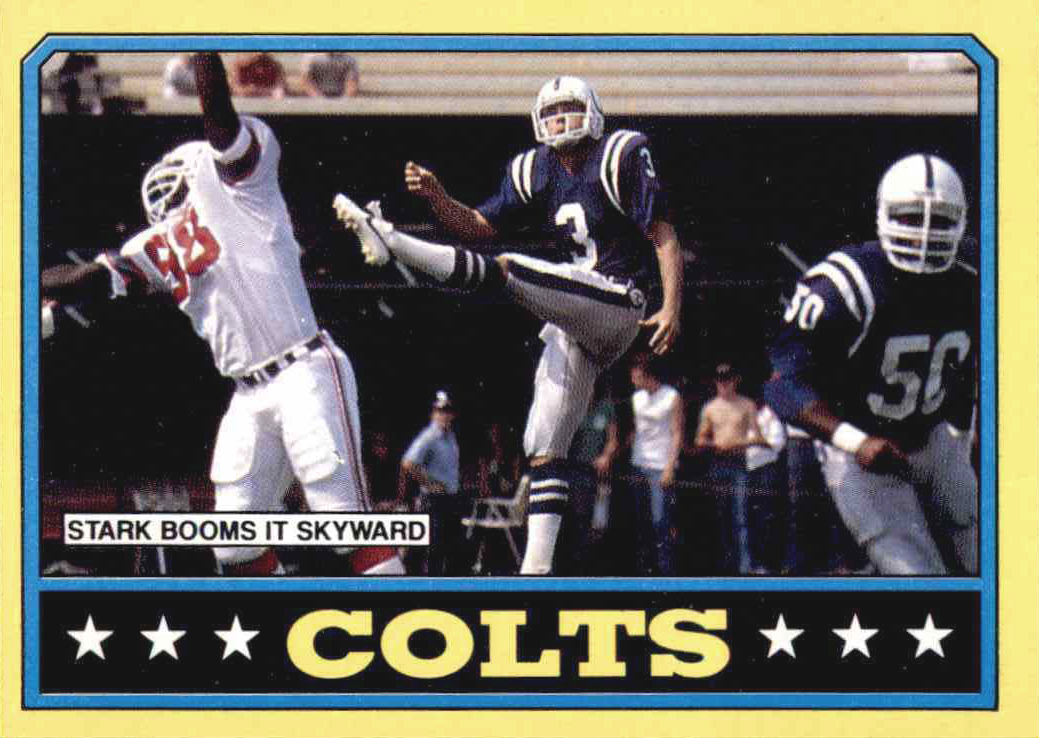
There's a lot going on here:


1986 Topps #314, Colts Leaders (Rohn Stark)


Consider the various examples of disorder and oddity.

(1) On the left, number 98 of the Patriots has been spun around in the wrong direction, we can assume during an attempt to reach up and deflect the punt. On the right, number 50 of the Colts is positioned a little bit better, heading downfield, but not exactly in the direction of the punt. The action resembles a scene from one of those vintage electronic football game tables where the figurines get vibrated all over the place.

(2) What's up with the dudes standing off the field in the background? One of them, toward the right of the frame, is shirtless. Another, just left of center, might be a security figure of some kind with blue shirt and hand on hip. In front of said security figure appears to be a folding lawn chair. And it seems like only the thinnest strand of rope is separating them all from the field.

(3) Look at the bleachers above the dudes. Aside from three fans hunched over on the left (and maybe a camera man?), the section is completely empty. And they're bleachers. Not individual seats. Seems odd for an NFL stadium.

But among all the discombobulation, there's punter Rohn Stark. Captured in the moment. Exhibiting perfect form.


Look at his eyes. They're focused on the flight of the football. He wants to make sure he's struck it well and aimed it true. And if that beautiful picture doesn't tell you enough, the caption on the bottom left—black text framed in a bright white box—tells you all you need to know:

STARK BOOMS IT SKYWARD

You can almost hear the sound of his foot striking the ball, can't you?

Look at that security figure in the background of the original card again. I think maybe he heard the sound too, and it was so sweet and pure and solid that he had to turn around and look.

What a moment to capture on cardboard.

And consider that life as a punter can't be easy. You're only called into the game for a few seconds at a time. And in those few seconds you've got to somehow catch the long snap and have absolute focus while 275-pound monsters are pushing ever closer toward you with the sole intent of stretching their arms out and smothering the ball as it leaves your foot.

For this punt, it looks like Stark found those few seconds of clarity.

It also seems like he found that clarity throughout his career. The four-time Pro Bowl member led the league in total punting yards in 1983 (4,124), and more impressively led the league in yards per punt in 1983 (45.3), 1985 (45.9), and 1986 (45.2). He finished second in 1982 and 1984.

And for one of those momentspure clarity and concentration amidst such chaos—1986 Topps Football #314 has a place in my box of favorites.

Sunday, August 9, 2020

From the Favorites Box: Samuel Morse, 1952 Topps Look 'N See #70

A series where I post some thoughts about favorite cards. Previous cards in the series are available here.


Here's a guy who is quite an important figure in world history. (But not for his beard, impressive as it may be.)

The letters and codes that appear to his left and right provide a clue.


I first learned of Morse Code as a young tot. Over the summers back then my mom, sister, and I would often go visit our grandparents in Queens, NY, and stay overnight. Grandpa in particular was a tinkerer. He had a workshop in the basement. He made art from pieces of wood. He played the violin and piano. In his younger days he served in the US Army as a mechanic and bugler. Seemed to know everything about everything, that guy.

One evening when things were winding down in the kitchen, Gramps brought out a small device made of plastic and metal, with a small battery attached by wires. He called it a telegraph. It probably looked something like this one:


He set it down on the kitchen table. Behind it he propped up a piece of cardboard that had a sheet of paper glued to the front. Printed on that paper was the alphabet, with a generous space between each letter. And next to each letter, various arrangements of dots and lines.

Well, Gramps proceeded to explain the telegraph to me, and how pressing down on that knob caused two pieces of metal underneath to touch and complete an electrical circuit, which allowed the telegraph to generate a distinct beeping sound. Once you let go of the knob, the lever would spring back up, the pieces of metal would separate, and the beep would stop. It was a combination of those beeps, sent by cables or radio wave, that allowed you to communicate over long distances. My primary-school brain soaked in everything as best it could. 

Essentially, there were only two beeps you needed to learn, a short one and a long one. He went over the first few letters of the alphabet with me, demonstrating the combinations of long and short beeps that made up each letter, and then showed me how to string the letters together with codes like "S.O.S." (dot-dot-dot / line, line, line / dot-dot-dot)

I gave it a try. Seeing my enthusiasm, Gramps left me to it and soon went up to bed, along with the rest of the family. But there I remained, sitting in the kitchen, beeping the alphabet away, a small lamp on the table the only light on in the house.

At some point, someone must have come back downstairs and told me "okay, that's enough for one night". But I don't exactly remember who it was, or how long they allowed me to keep clicking away on that lever. 

Here's more information on the telegraph and Morse Code from the back of the card.


Note the secret message you're asked to find at the bottom.

Last year I shared the first card I picked up from this 1952 Topps Look 'N See set, featuring one of my all-time favorite authors, Jules Verne. I tried placing a piece of red cellophane on top of that one to decode the message, but it just wasn't coming out clearly enough, possibly from a fading or aging of the blue-ish ink used for the secret image. (If you look closely at the card back above, you can see something of an image behind the text.)

Eventually I was able to decode it by scanning the card, opening it in Photoshop, and placing a red-colored transparent layer on top, so I wanted to try again here.

The question we have to answer this time: 

What was the first message sent by wireless?  

(Get ready before you scroll down, it's rather bright)


*
*
*
*
*
*
*
*
*
*
*
*
*


What hath God wrought?

On May 24, 1844, Samuel Morse, who was at the US Capitol, and Alfred Vail, his colleague at the other end of the line at a railroad station in Baltimore, wanted to share a message that would capture the awe and amazement of the onlookers that day, and after that, the world.

It's difficult to make out details of the telegraph itself in the image, but you can see an illustrated Morse tapping away at a device. Regardless, I know I would have enjoyed decoding this card if I'd been a kid in 1952.

And for the great memories of Grandpa, one of my best friends in the world, 1952 Topps Look 'N See #70 has a place in my box of favorite cards.


Bonus Feature: MORSE CODE CHALLENGE

Take a minute and translate the following.

-. .. -.-. . / -... . .- .-. -.. / ... .- -- ..- . .-.. -.-.--

Sunday, June 28, 2020

From the Favorites Box: Brian Propp, 1981-82 Topps #E110

A series where I post some thoughts about favorite cards. Previous cards in the series are available here.


The tough thing about hockey is that it's fast. Sometimes there's a giveaway at a bad time. Transition up the ice happens in an instantand at a moment when you might be a bit flat-footed.

The great thing about hockey is that for just a moment, for a few hard strides, you do have the opportunity to catch up. And I think that's where Brian Propp might find himself here.


Look at the expression on his face. He's grinding. He's looking up the ice, either toward an opponent he needs to cover or toward his teammate who's rushing through the neutral zone with the puck. The card's design even lends itself to action, with that bright yellow team name flying across on the diagonal, and the thin, rounded orange border giving you a great little portal into the scene.

And speaking of action, Brian Propp was no stranger to the offensive side of it. Check out these stats from his 15-season career:

1016 GP, 425 G, 579 A, 1004 PTS, 825 PIM, 59 GWG

Even for a guy who played throughout the high-scoring 1980s, you can't shake a stick at those numbers. To back them up, here's more:

In a five-season stretch, Propp reached the 40-goal mark four times, and just missed hitting the mark in all five.

1981-82: 44
1982-83: 40
1983-84: 39
1984-85: 43
1985-86: 40

He had a couple of great playoff runs with Philadelphia, too, most impressively in 1986-87 when the Flyers made it to the Stanley Cup Finals, losing to Edmonton:

26 GP, 12 G, 16 A, 28 PTS, 5 PPG (tied for league lead), 104 SOG (led the league)

For certain we're looking at a great career, not to mention a great hockey jersey and a great hockey card design. But for reminding us of the grind and how great it isthat's why 1981-82 Topps #E110 has a spot in my box of favorite cards.
Sunday, May 31, 2020

From the Favorites Box: Pete Rose, 1986 Fleer #191

A series where I post some thoughts about favorite cards. Previous cards in the series are available here.

Here's Pete Rose, representing his Cincinnati team with a red warm-up jacket, red helmet, red batting gloves, and almost a smile.


1986 Fleer #191, Pete Rose


More accurately, perhaps it's the look of determination that comes before some hard work in the batting cage (or the look of fulfillment that comes after).

Why do I say that? 

Look closely at the barrel of his bat:


Is it just me, or has the black paint been completely worn off around the sweet spot?

How many batting practice sessions does it take to even do that?

It reminds me of a story:

During my college hockey days, our home rink was also the practice rink of the New York Islanders. We'd have our practices early in the morning, and on rare occasion the Islanders would come on for a practice afterward. If we didn't have to immediately get to class, a few of us would hang around, sit in the stands, and watch the professionals go through their drills. It was a treat.

And who do you think was often the first player on the ice? 

The healthy scratches? 

No. 

The backup goalie? 

No. 

The recent call-up from the minor leagues

No. 

It was Ziggy Palffy. 

At the time Mr. Palffy was a star, scoring more than 40 goals per year. He was by far the best player the Islanders had. 

And there he was, stepping onto the ice as soon as the Zamboni drove off.

It goes to show that talent might give you a chance at the professional ranks, but only hard work will get you there and keep you there year after year. And if you're gunning to become the player with the most hits in the history of Major League Baseball, like Mr. Rose did in 1985 (the year this picture was likely taken), you put in that hard work for more than two decades. Until the paint wears off the barrel of your bat.

For sticking to that work ethic no matter who you are, and having the physical evidence to show for it, 1986 Fleer #191 has a place in my box of favorite cards.

Sunday, April 19, 2020

From the Favorites Box: Claude Lemieux, 1987-88 O-Pee-Chee #227

A series where I post some thoughts about favorite cards. Previous cards in the series are available here.


I know, I know, what a jerk, right? 

Many people remember Claude Lemieux this way, in large part from his actions in a playoff game against Detroit where he hit Kris Draper from behind, sending him face-first into the boards. Draper sustained numerous facial injuries as a result.

"Not the only dirty play from that guy", you might be saying. And you'd be right.

But hear me out.

Any good story needs heroes and villains, and Claude Lemieux, despite what most of us so readily remember, played both roles throughout his NHL career very well. That's quite rare, and I think you could even call it remarkable.

Consider these numbers:

1,215 games played
379 goals
407 assists
786 points
1,777 penalty minutes 
58 game-winning goals

Also consider that across his career he put up five 30-goal seasons, and came very close to four more (29, 27, and 27, and 26).

They're not exactly Hall of Fame numbers, but then there's also this:

Claude Lemieux's name appears on the Stanley Cup four times. He won it with Montreal as a rookie in 1985-86, with New Jersey in 1994-95, with Colorado in 1995-96, and with New Jersey again in 1999-00.

And he wasn't just along for the ride on any of those championship teams. In that rookie season with Montreal, for example, he scored 16 points in 20 playoff games, including 4 game-winning goals. In 1994-95 he led the entire league with 13 playoff goals, taking home the Conn Smythe trophy as MVP. And even in 1996-97, a season when his Colorado Avalanche lost in the semifinals to the Detroit Red Wings, Claude put up 13 goals to tie for the NHL lead, four of those again being game-winners.

Let's dive even a little deeper. Here are the ten players who've scored the most game-winning goals in the Stanley Cup playoffs throughout their careers:

Brett Hull: 24
Wayne Gretzky: 24
Joe Sakic: 19
Claude Lemieux: 19
Maurice Richard: 18
Mike Bossy: 17
Chris Drury: 17
Glenn Anderson: 17
Patrick Marleau: 16
Jaromir Jagr: 16

Did you catch the guy who's fourth from the top, with 19?

That number doesn't happen by accident. That's a coach putting a player out there when the team needs a goal, and when a championship is within reach. Just look at all the other names on that list, my goodness; every one a brilliant, clutch player. Now try being a guy with that ability while simultaneously playing a rough, sometimes over-the-edge game that makes you the cowboy in the black hat.

I don't think many players would want that role. I don't think many players are capable of even playing that role.

What's the point of all this?

To be clear, I'm not asking you to soften your stance on the guy. You can still hate him all you want.

But as you look at young Claude Lemieux on that rookie card and see his laser focus as he bears down on the goalin pre-game warmupsjust remember there's more to the picture. 

And for playing both the hero and villain better than just about anyone in the page-turning story that is professional hockey, 1987-88 O-Pee-Chee #227 has a spot in my box of favorite cards.

Sunday, February 16, 2020

From the Favorites Box: Sandy Alomar, 1973 Topps #123

A series where I post some thoughts about favorite cards. Previous cards in the series are available here.


Now batting for the Angels. . . number two. . . second baseman. . . Sandy Alomar. . .

That announcement through the P.A. system could be right where we find ourselves as we look through the thin black frame and into the story being told on this card.

Mr. Alomar has just stepped into the batter's box, there's a lull in the crowd, and the catcher is silently transmitting signals to the pitcher who stands on the mound about 60 feet away.

The thing is, sometimes we don't think about how much hard work a hitter puts in every single day just to get into that batter's box. Physical training, mental training, batting practice, studying tendencies of various pitchers. Even choosing the right model bat takes time and effort.

And if a hitter plugs all of those variables into the equation successfully, the result is bound to be a boost in confidence. It's a pretty great feeling for an athlete to have. And if you look closely at this card, you'll see that Alomar's got it.

It's in the way he's hitching up his pant leg with one hand while he twirls the bat toward the pitcher with the other. You can't help but think the next scene in the story will involve Sandy grabbing that bat with both hands, getting into his stance, and drilling the next pitch somewhere.

For putting in all the work, day in and day out, in order to step into the batter's box with confidence, 1973 Topps #123 has a place in my box of favorite cards.

Sunday, January 12, 2020

From the Favorites Box: Mark Gastineau, 1982 Topps #168

A series where I post some thoughts about favorite cards. Previous cards in the series are available here.

If I were to use just one football card to describe the sport to a person who'd never seen it, this might be the card I'd choose. 


Now, you could show that person a card of a quarterback in a throwing motion, or a wide receiver stretching out to catch a pass, or a running back dodging defenders. Those kinds of images make attractive cards. Those positions are the glamorous ones.

But to me, you can't define football (especially older-school football) without showing the Goliaths, the behemoths on the line, grappling with each other for every inch of real estate they can gain. Defending. Attacking. Pushing. Countering. You can hear the NFL soundtrack by Sam Spence, can't you?

And for a few years in the 1980s, hardly anyone did the attacking part of it better than defensive end Mark Gastineau. Look at the card above again. He's being double-teamed (as he often was), but still appears to be giving both of those Cleveland Browns more than their share of trouble. That defender on the lefthis jersey is soaked in mud and water, as if Gastineau has already walked all over him a few times.

And really, how are either of them going to stop a guy who's 6-foot-5, 275 pounds, and can run the 40 in 4.5 seconds? Even his hair and mustache combo is all-pro.


To provide an example of the damage the five-time Pro-Bowler did on the gridiron:

In 1983, the year after the football card shown above was released, Gastineau put up 19 quarterback sacks to lead the league. In 1984 he would lead the league again with a whopping 22. Then in 1985 he'd add another 13.5, good for 6th place. Hard to top that three-year total.

I'm not going to mention much about the "sack dances" that ruffled so many feathers back then, although I can understand why they did elicit such a response. I probably wouldn't have liked them, either. And did other defensive linemen display histrionics like that in the 1980s? No.

But it's not easy to toil in the trenches, battling with 300-pound monsters on the pass rush all day. What made Gastineau different was that despite the grind, he still somehow played the sport with passion and a childlike effervescence. Maybe the sack dances stemmed from that sort of enthusiasm, and not from the desire to taunt a defender or quarterback. That's only a guess, and it might be painting too kind of a picture, but in any case I'm not going to criticize the guy for it. Besides, I'm sure the home-team fans ate that stuff up.

For reminding us that it's possible to toil in those trenches, succeed, and even have fun doing it, 1982 Topps #168 has a spot in my box of favorites.

Sunday, November 24, 2019

From the Favorites Box: John Candelaria, 1976 Topps #317

A series where I post some thoughts about favorite cards. Previous cards in the series are available here.

Have a look at Brooklyn-born pitcher John Candelaria on his rookie card:


I think I see a little bit of that New York swagger.

He's looking down toward the camera lens (all 6-foot-7 of him), pounding his fist into that mitt, head tilted, hair whipping in the breeze.

It's a look that's sometimes mistaken for cockiness, or a bad attitude. And let's be fairwith some New Yorkers that's exactly what it is. But I don't think that's the case here. What you're seeing instead is a combination of confidence and youthfulness.  

Try and hit this pitch. 

Let's say you're stepping into the batter's box right now. Regardless of what you say to young Candelaria theretrash talk, psych-outs, put-downs, whatever you could do to take him off his gameyou just get the feeling that he's going to throw the next pitch right past you anyway.

And the very next year, 1977, he sure did prove it.

The youngster would go 20-5 with 133 strikeouts, 6 complete games, and a league-leading 2.34 ERA. Such a dominant performance earned him a spot on the National League All-Star team. And just two years later he'd move beyond All-Star status, playing an important role in bringing the Championship to Pittsburgh.

"The Candy Man" would start Game 1 of the 1979 NLCS against the Cincinnati Reds, pitching seven strong innings to help his Pirates to a win. His team would also take the next two games to sweep the Reds right out of the playoffs.

Then in Game 6 of the World Series, with the Pirates down to the Baltimore Orioles 3 games to 2, Candelaria took the mound. He threw six great innings of shutout ball, earning a big win to keep the Pirates in the Series. The next day his team would take Game 7 and the Championship.

Despite that early-career success, though, Candelaria would never get back to that high ground of a Championship. And after about 10 seasons in Pittsburgh, the second half of his career resembled that of a journeyman. Angels, Mets, Yankees, Expos, Twins, Blue Jays, Dodgers, and then back to the Pirates for one final season.

But all told, in 19 years of Major League ball Candelaria went 177-122 with a 3.33 ERA, 54 complete games, and 1,673 strikeouts. Not too shabby.

And he probably still has some of that late-'70s New York swagger. I mean, just look at his mitt again. Zoom in on the pinky finger. 


It has "CANDY" written across it in big, bold letters.

For providing us with a glimpse of what it's like to be a care-free, talented 21-year-old pitcher in the big leagues, 1976 Topps #317 has a spot in my box of favorite cards.