Showing posts with label 1952 Topps Look N' See. Show all posts

Sunday, April 3, 2022

From the Favorites Box: Theodore Roosevelt, 1952 Topps Look 'N See #6

A series where I post some thoughts about favorite cards. Previous cards in the series are available here.
 
The man featured on today's card is an absolute legend in my book. Many of you likely know a thing or two about him—if not from what you may have learned in school, then from numerous books and television documentaries about him. (The PBS series about some of the key members of the family is worth a watch.)
 
And as card collectors and sports fans, you might also know this man from a portion of a certain speech he gave that's been quoted by a few athletes over time, none bigger than Tom Brady.
 
The full speech is titled "Citizenship in a Republic", and the entire thing is powerful. I'll add a quote here from the specific portion that's so popular with athletes. After reading it, I think you'll see why.
 
"It is not the critic who counts; not the man who points out how the strong man stumbles, or where the doer of deeds could have done them better. The credit belongs to the man who is actually in the arena, whose face is marred by dust and sweat and blood; who strives valiantly; who errs, who comes short again and again, because there is no effort without error and shortcoming; but who does actually strive to do the deeds; who knows great enthusiasms, the great devotions; who spends himself in a worthy cause; who at the best knows in the end the triumph of high achievement, and who at the worst, if he fails, at least fails while daring greatly, so that his place shall never be with those cold and timid souls who neither know victory nor defeat."
 
Softball season just started over here, and I know I'm ready to slug some hits and get dirty in the field.

No more beating around the bush, though. Here's the man himself, on cardboard.
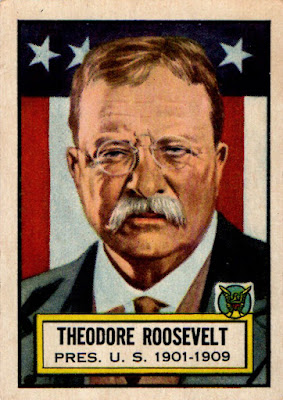


This Theodore Roosevelt card is one of the bigger hitters in the 1952 Look 'N See set, but you know what? I'd hardly purchased any cards for my collection in 2021, and I definitely wanted a copy of this one, so I found a decent deal online and went for it.

What pushed me to the point of purchase, however, was not anything I've mentioned above. It was a result of reading a book that Roosevelt wrote a few years after his second term in office called Through the Brazilian Wilderness.
 
Accepting an invitation from some highly regarded Brazilian leaders and naturalists, Roosevelt and his son Kermit would travel to the country and help chart some of its unexplored areas on foot and by dugout canoe, cataloguing some never-before-seen animal, insect, and plant species along the way.

It was a monumental task. The team would have to venture down uncharted rivers (including one called "The River of Doubt"), fend off snakes and swarms of insects, endure poor weather, rapids, near starvation, injury, sickness, the whole nine yards. And Roosevelt was in his mid-50s by then. 
 
But his vigor remained. Just read this statement from the man regarding the journey he and his American-Brazilian team completed. It's one of my favorites in the entire book.

No man has any business to go on such a trip as ours unless he will refuse to jeopardize the welfare of his associates by any delay caused by a weakness or ailment of his. It is his duty to go forward, if necessary on all fours, until he drops.

And there were times in the journey when they really were pushed that far. Here's another excerpt:
 
Kermit's experience in bridge building was invaluable in enabling him to do the rope work by which alone it was possible to get the canoes down the canyon. He and Lyra had now been in the water for days. Their clothes were never dry. Their shoes were rotten. The bruises on their feet and legs had become sores. On their bodies some of the insect bites had become festering wounds, as indeed was the case with all of us. Poisonous ants, biting flies, ticks, wasps, bees were a perpetual torment. However, no one had yet been bitten by a venomous serpent, a scorpion, or a centiped, although we had killed all of the three within camp limits.
 
I think people were indeed tougher back then.
 
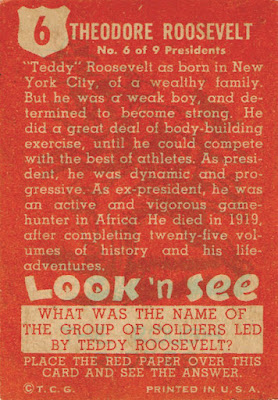
But let's get back to the card now. Here's the text and design on the reverse:


I might be a little partial because Mr. Roosevelt is such an icon to me, but the motivation I receive from reading about him seems almost limitless. Here's one more quote from "Citizenship in a Republic".
 
To say that the thriftless, the lazy, the vicious, the incapable, ought to have the reward given to those who are far-sighted, capable, and upright, is to say what is not true and can not be true. Let us try to level up, but let us beware of the evil of levelling down. If a man stumbles, it is a good thing to help him to his feet. Every one of us needs a helping hand now and then. But if a man lies down, it is a waste of time to try to carry him; and it is a very bad thing for every one if we make men feel that the same reward will come to those who shirk their work and to those who do it.
 
Strong points for the world in which we currently live.
 
Now it's time to decode the card back. The text box at the bottom of the card asks, "What was the name of the group of soldiers led by Teddy Roosevelt?"

Know the answer? 
 
Okay, time to place my digital red cellophane paper atop the card.
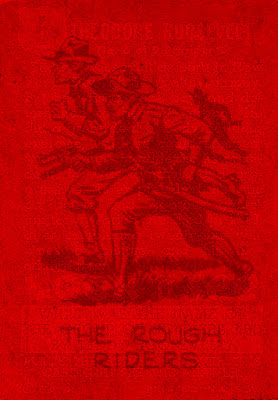


The Rough Riders. Bully for the whole unit. Bully for Colonel Roosevelt. Bully for all of you readers and collectors.

And for continuing to motivate us to get off our duffs and accomplish great things—more than 100 years now since he first spoke those words quoted above—1952 Topps Look 'N See #6 has a place in my box of favorites.

Sunday, June 6, 2021

Look 'N See, Times Three

A couple of years ago, I discovered a cool little set of cards put out by Topps way back in 1952 called Look 'N See. The 135 cards in the set feature famous authors, poets, inventors, explorers, scientists, and more. Some were contemporary at the time. Many others were from history.

Quickly I found one of my favorite authors, Jules Verne, and snatched up his card for a bargain. 

A year and a half later, I grabbed a card featuring Samuel Morse, as it brought back a great childhood memory involving my grandfather. 
 
Recently I looked through the checklist again and found three more cards I thought I'd like to add to my collection. Even better, after a search on eBay, I found all three being offered by the same seller—and for just a few dollars each.
 
Now, these three cards don't quite qualify for Favorites Box entry like the first two, but I did purchase them for various reasons of admiration that I'll describe here.
 
First up is American author Washington Irving. Fond memories of reading his stories go all the way back to my childhood. Many folks are familiar with his works like "The Legend of Sleepy Hollow" and "Rip Van Winkle". I'd also highly recommend a collection of short stories called Tales of the Alhambra
 
Another reason I like this guy is that he's a native New Yorker like me, and that I currently live on the Hudson River, not too far from the actual village of Sleepy Hollow (yep, it's an actual place) and another town called Irvington, named after the author himself.


Notice the question on the back: What character who slept for 20 years was created by Washington Irving?

Here's the decoded message, done by placing a digital version of red cellophane paper on top of the card back.


Next up is the incredible Isaac Newton. I admire this man for the sheer width and breadth of his knowledge and brilliance. Science, mathematics, optics, gravitation, laws of motion, you name it. He was also quite a philosopher and even delved deeply into the Bible, citing, for example, how the stars and planets—as precisely as they moved about the solar system under the law of universal gravitation—could not have been placed in their orbits without the help of some intelligent creator.


The question on the back of his card: What led Newton to discover the laws of gravity? 
 
And here's the decoded message.


And finally, we've got Wilbur Wright. More nostalgia factor here, specifically involving the field of aviation. I grew up on Long Island, very close to the famous airstrip that was used not only by Amelia Earhart, but also by Charles Lindbergh when he began his remarkable trans-Atlantic flight in The Spirit of St. Louis. (Lindbergh has a card in this set as well, but it can be a bit pricey.)
 
The little town in which I grew up even has a few streets named after pioneers of the field like Curtiss, Lansdowne, Lindbergh, and Wright. In addition, a couple of towns away there are some wartime-era airplane hangars that have since been converted into The Cradle of Aviation Museum. Lots of cool exhibits there, especially if you're an airplane/spaceflight buff.


The question here: How long did the first flight of an airplane last?
 
And here's the decoded message. 


Brother Orville didn't receive a card in the set, but maybe that's him running exuberantly after the plane.
 
I've really enjoyed adding these Look 'N See cards to my collection. Not only are they some of the oldest I own, but they've been more than affordable so far. On top of that, they feature some great luminaries from history. And on top of that, I get to do some cool secret agent–style decoding work for each card. That's a win-win-win-win.
 
Thanks for reading, as always.

Sunday, August 9, 2020

From the Favorites Box: Samuel Morse, 1952 Topps Look 'N See #70

A series where I post some thoughts about favorite cards. Previous cards in the series are available here.


Here's a guy who is quite an important figure in world history. (But not for his beard, impressive as it may be.)

The letters and codes that appear to his left and right provide a clue.


I first learned of Morse Code as a young tot. Over the summers back then my mom, sister, and I would often go visit our grandparents in Queens, NY, and stay overnight. Grandpa in particular was a tinkerer. He had a workshop in the basement. He made art from pieces of wood. He played the violin and piano. In his younger days he served in the US Army as a mechanic and bugler. Seemed to know everything about everything, that guy.

One evening when things were winding down in the kitchen, Gramps brought out a small device made of plastic and metal, with a small battery attached by wires. He called it a telegraph. It probably looked something like this one:


He set it down on the kitchen table. Behind it he propped up a piece of cardboard that had a sheet of paper glued to the front. Printed on that paper was the alphabet, with a generous space between each letter. And next to each letter, various arrangements of dots and lines.

Well, Gramps proceeded to explain the telegraph to me, and how pressing down on that knob caused two pieces of metal underneath to touch and complete an electrical circuit, which allowed the telegraph to generate a distinct beeping sound. Once you let go of the knob, the lever would spring back up, the pieces of metal would separate, and the beep would stop. It was a combination of those beeps, sent by cables or radio wave, that allowed you to communicate over long distances. My primary-school brain soaked in everything as best it could. 

Essentially, there were only two beeps you needed to learn, a short one and a long one. He went over the first few letters of the alphabet with me, demonstrating the combinations of long and short beeps that made up each letter, and then showed me how to string the letters together with codes like "S.O.S." (dot-dot-dot / line, line, line / dot-dot-dot)

I gave it a try. Seeing my enthusiasm, Gramps left me to it and soon went up to bed, along with the rest of the family. But there I remained, sitting in the kitchen, beeping the alphabet away, a small lamp on the table the only light on in the house.

At some point, someone must have come back downstairs and told me "okay, that's enough for one night". But I don't exactly remember who it was, or how long they allowed me to keep clicking away on that lever. 

Here's more information on the telegraph and Morse Code from the back of the card.


Note the secret message you're asked to find at the bottom.

Last year I shared the first card I picked up from this 1952 Topps Look 'N See set, featuring one of my all-time favorite authors, Jules Verne. I tried placing a piece of red cellophane on top of that one to decode the message, but it just wasn't coming out clearly enough, possibly from a fading or aging of the blue-ish ink used for the secret image. (If you look closely at the card back above, you can see something of an image behind the text.)

Eventually I was able to decode it by scanning the card, opening it in Photoshop, and placing a red-colored transparent layer on top, so I wanted to try again here.

The question we have to answer this time: 

What was the first message sent by wireless?  

(Get ready before you scroll down, it's rather bright)


*
*
*
*
*
*
*
*
*
*
*
*
*


What hath God wrought?

On May 24, 1844, Samuel Morse, who was at the US Capitol, and Alfred Vail, his colleague at the other end of the line at a railroad station in Baltimore, wanted to share a message that would capture the awe and amazement of the onlookers that day, and after that, the world.

It's difficult to make out details of the telegraph itself in the image, but you can see an illustrated Morse tapping away at a device. Regardless, I know I would have enjoyed decoding this card if I'd been a kid in 1952.

And for the great memories of Grandpa, one of my best friends in the world, 1952 Topps Look 'N See #70 has a place in my box of favorite cards.


Bonus Feature: MORSE CODE CHALLENGE

Take a minute and translate the following.

-. .. -.-. . / -... . .- .-. -.. / ... .- -- ..- . .-.. -.-.--

Sunday, February 24, 2019

From the Favorites Box: Jules Verne, 1952 Topps Look 'N See #97

A series where I post some thoughts about favorite cards. Previous cards in the series are available here.

Jules Verne is one of my favorite authors. 20,000 Leagues Under the Sea and The Mysterious Island have been important parts of my library since childhood.
 

And I'd like to say the timing worked out so perfectly that this Jules Verne card from the 1952 Topps Look N' See release was exactly the 20,000th card I acquired for my collection. However, being that I didn't even know how many cards I had in my collection until recently, I can't make that claim.

Anyhow, back to the card itself. At about 2" x 3", it's smaller than a standard-sized baseball card. But if the front still looks familiar, you're onto something. The Topps baseball card design from the same year, 1952, sported quite a similar look. 


Just replace the solid yellow border around the name with a marquee, and replace the "Famous Writers" icon with a team logo, and there you go.

The card backs are different, though, with a brief write-up on the luminary pictured on the front. Also included is a cool little feature where you've got to decode the answer to a question using a piece of red cellophane. (If you look closely at the card back you can just make out some inconspicuous shapes printed in light blue ink, hiding behind the main paragraph.)


So, what inventions did Jules Verne predict in his books?

Well, I happen to have a piece of red cellophane for just such an occasion, so when this card arrived in the mail I went to work.

After placing the cellophane on top of the card I did see something that resembled a hidden image and text, but it was barely coming though. Faded ink over 65+ years? Maybe.

Regardless, it certainly wasn't clear enough to share here on the blog. So the next thing I tried was to place the card face-down, along with the cellophane, into my scanner to see if the digital result was any more legible. Nope. Not much different at all. But then I thought, Hey, wait! Photoshop!

So, after much tinkering with red semi-transparent layers and then some color balancing and contrast adjustments, I was able to produce a decoded version that was good enough to share, although still not the easiest to read. 

The answer to the question? (Get ready before you scroll down, it's really bright)

*
*
*
*
*
*
*
*
*
*
*
*
*

I wonder if this is where Takara/Hasbro got
the idea for their Transformers decoder


After your eyes adjust, you'll see the answer is submarines, airplanes, and television. (That's a little school of fish underneath the submarine.) It's interesting that you can still just barely see the "Look 'N See" text peeking through the red filter, running across the card just below the school of fish. I don't know. Maybe cellophane paper was better in the 1950s.

Back to the set: There are 135 cards in all, including authors, poets, inventors, explorers, scientists, and more. Trying to complete it, however, is not on my to-do list, mostly because the cost of certain cards outweighs my desire for them (in halfway decent condition, Amelia Earhart, Teddy Roosevelt, Rembrandt, and Babe Ruth cards usually run about $50 apiece).

I'm happy to have a card of the father of science fiction in my collection, though (and in my favorites box), and wouldn't mind picking up a few other cards from the set.

Thanks for reading!


*It turns out I have just over 20,000 cards in my collection, so although this particular card may not have been number 20,000, it is one of 20,000.