Showing posts with label USSR. Show all posts

Sunday, October 15, 2023

Completed Set: 1991-92 Red Ace Russian Stars in NHL

Full disclosure, right from the start: 
 
This isn't a typical "completed set" post, in the sense that it didn't involve months (or years) of picking up a few cards here and there until I had all of them. The truth is, I just bought the boxed set of 17 cards.
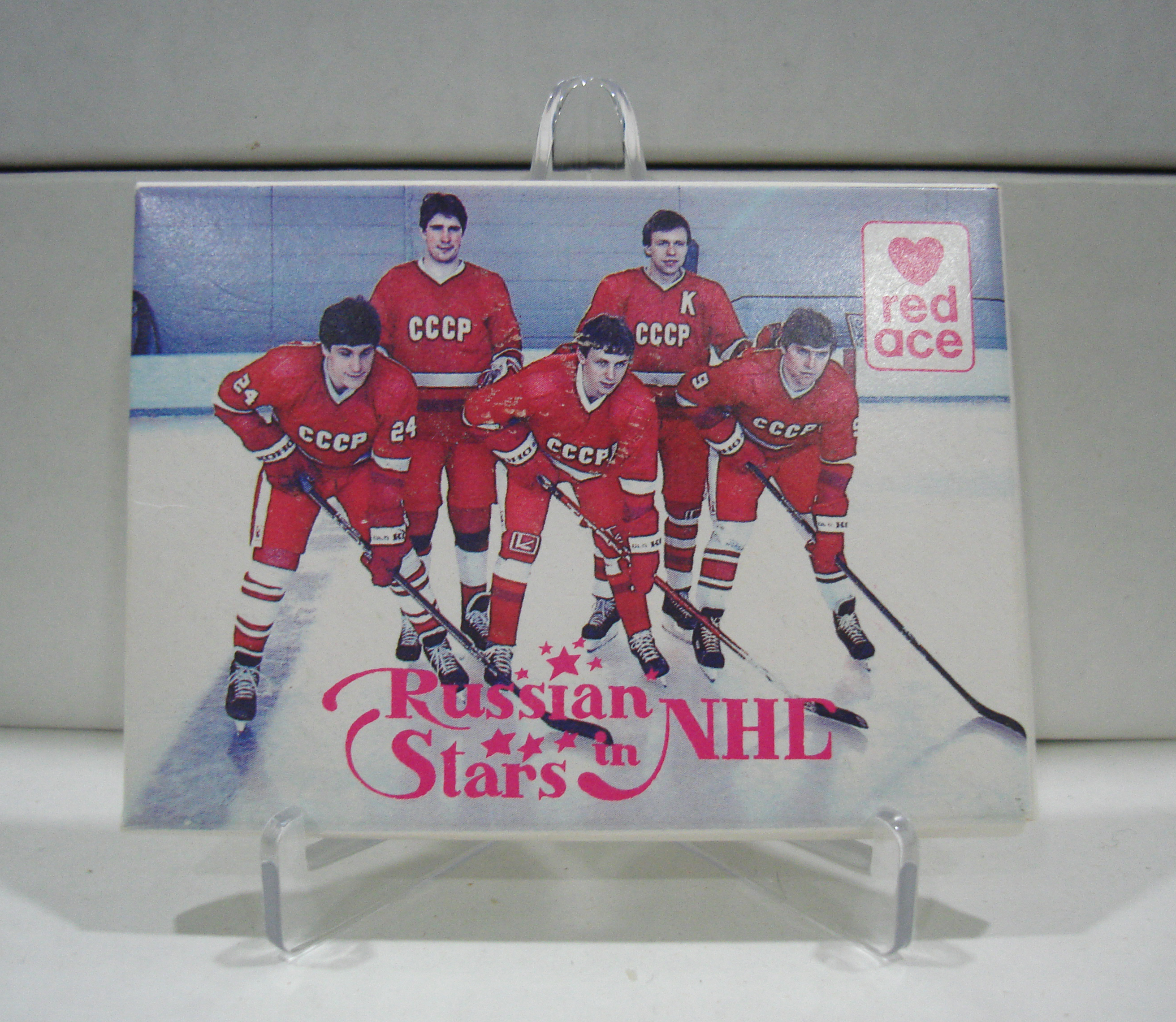


One and done.
 
But I wanted to do a write-up regardless, because this set hearkens back to a very interesting time in the NHL, and in the world. Only a couple of years before the cards were released, the first Soviet players had defected for the NHL. Their brand of hockey—an astounding combination of speed, strength, finesse, calculated maneuvers, and puck possession—was quite different from the dump-and-chase, north-south, physical punishment style in North America. Quickly the average hockey fan would discover that the Russian game was something to behold. And with the end of the Soviet regime in 1991, which allowed Russian players to freely join the NHL, it's no surprise that trading card companies like this little Russian brand jumped in on the action to promote the new stars.
 
Instead of showing some of my favorite cards in the set and spending time describing the various subsets and design features, like I would do with a more typical, larger set, I'm just going to post all 17 cards below, along with a brief description of each player's NHL career. Because the cards are not numbered on the back, we'll go in alphabetical order by surname. Let's see how many of these guys turned out to be "Red Aces".


Pavel Bure 
Well, that started off with a bang. Bure's first season in the NHL was 1991-92, and he lit things up in Vancouver with 34 goals in only 65 games played. The 20-year-old took home the Calder trophy as rookie of the year, and terrorized defenses and goalies from his first NHL game to his last. Knee injuries limited Bure's career to just 12 seasons, but "The Russian Rocket" still put up 437 goals in 702 games played, and earned a trip to the Hockey Hall of Fame.


Evgeny Davydov
After having good success with CSKA Moscow for 6 seasons, Davydov joined the Winnipeg Jets in 1992-93. The winger didn't disappoint, posting 28 goals and 21 assists for 49 points in 79 games played. He didn't repeat that performance the next season, however, and after bouncing around from the Panthers to the Senators for a couple of years, he went to Europe, where he exhibited his hockey skills in professional leagues from Sweden to Switzerland to Germany to Finland to Italy to Russia, all the way through the 2002-03 season.


Sergei Fedorov
Sergei might be the biggest Ace here. What a skill set on this guy! He was one of the fastest skaters in the league, a two-time Selke Trophy winner (best defensive forward), and a three-time Stanley Cup winner who put up almost 500 goals and 700 assists in his career. During the 2017-18 NHL season, Fedorov was named as one of the NHL's top 100 players as part of their 100th anniversary celebration. The word "dynamic" might be overused in sports, but I'll say it anyway: Fedorov was a dynamic player, and I thoroughly enjoyed watching him during my high school and college hockey-playing days.


Viacheslav Fetisov
Slava might be the other biggest Ace in the set. This was already well known in 1991-92, however, as he was a vital defensive part of many Soviet "Red Army" championship teams throughout the 1980s. Later in the 1990s he'd help Detroit win two Stanley Cups, along with Sergei Fedorov. And just like Fedorov, Slava is a member of the Hockey Hall of Fame.
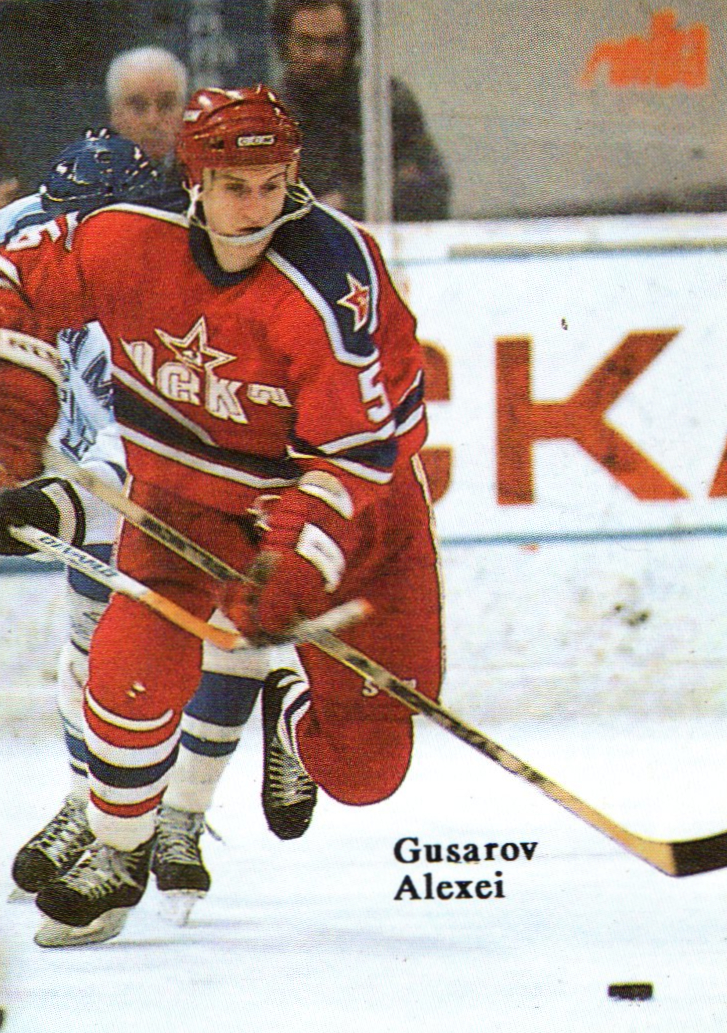


Alexei Gusarov
The defenseman had a solid 11-year career in the NHL, starting out as a 26-year old in 1990-91 with the Quebec Nordiques. He'd move with the team to Colorado, and would help them win their first Stanley Cup in 1995-96, alongside the next guy in this set. 
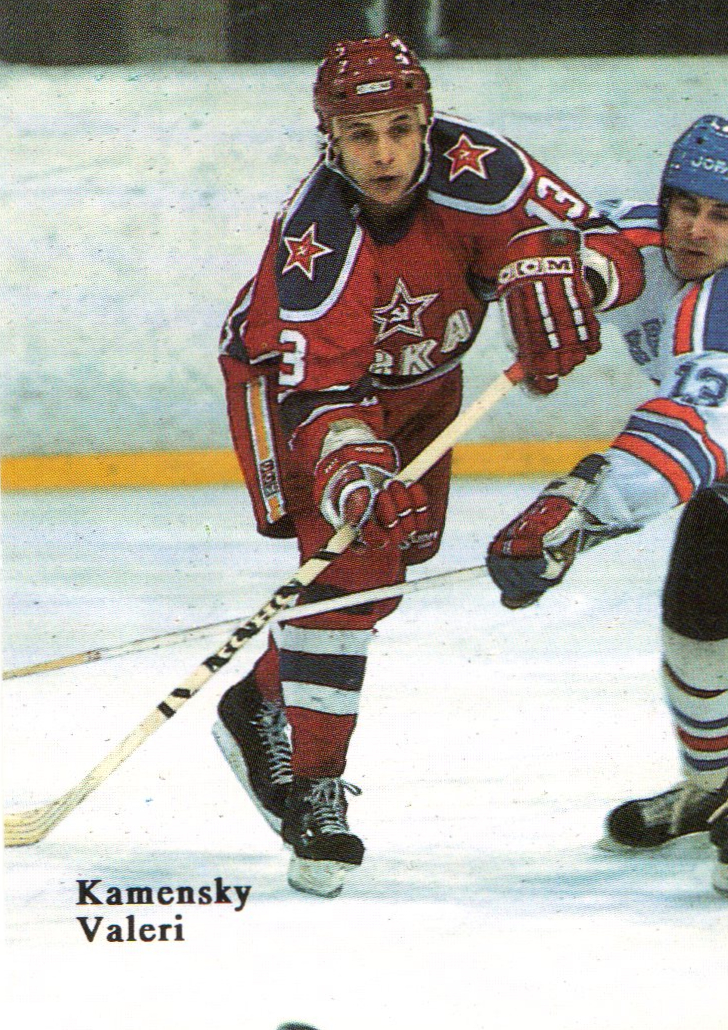


Valeri Kamensky
Kamensky joined the Nordiques one year after Gusarov, and after a couple of seasons in the league he really started to show his offensive skills. The winger hit his peak perfectly, putting up a career-high 38 goals and 47 assists for 85 points in 81 games played during the Avalanche's Stanley Cup season. He rolled right into the playoffs that year, too, adding 22 points in 22 games (10 goals, 12 assists).


Alexei Kasatonov
Like Fetisov, Kasatonov was a defensive stalwart on those nearly unstoppable Soviet National teams of the 1980s. He slotted right in with New Jersey in 1989-90, alongside Fetisov, and put up some very good numbers there. He was selected by the Mighty Ducks in their 1993 expansion draft, however, so he missed out on New Jersey's first Stanley Cup by just a couple of years.
 

Now that we're a few cards into the set, let's talk about the design. There's really not much to describe for the fronts. However, the full-bleed image was still a pretty new thing for trading cards in 1991-92, and I think it works well here. Listing the player's surname on top of their first names is an interesting touch. But the photography is decent, and there's some good hockey action captured throughout the set.


And the card backs? They're so-so: Not as chock-full of information as 1988 Score Baseball, but not too sparse, either. For such a small company that only appeared to produce this hockey card set for two seasons, I'm not going to be nitpicky about that, or other things like the thin card stock. (The cards are quite flimsy.) Besides, the full-color headshot is a plus, for sure. Now let's get back to the players.


Ravil Khaidarov
Khaidarov is the only player on this list who didn't log any NHL games. He left Dynamo Moscow after the 1991-92 season for the German professional leagues, and played there for a dozen years. In 1995-96 he put up some gaudy numbers with Freiburg: 46 goals and 81 assists for 127 points in just 51 games played.


Vladimir Konstantinov
Konstantinov was a talented defenseman who joined the Red Wings as a 24-year-old in 1991-92. He helped the Wings to their Stanley Cup Championship in 1996-97, along with fellow Red Aces Sergei Fedorov, Slava Fetisov, and Igor Larionov. Sadly, he suffered injuries in a car accident soon after the Cup victory that ended his playing career.


Igor Kravchuk
Kravchuk was a solid defenseman for numerous NHL teams over a 12-year span. In 1993-94 with Edmonton, he put up a career-high 12 goals and 38 assists for 50 points in 81 games played. "Igor Kravchuk" is a fun name to say, too.


Igor Larionov
Larionov was one of my favorite players of the 1990s because of the way he "thought" the game. So smart. So crafty. After many phenomenal years with guys like Fetisov and Kasatonov on the Russian Red Army teams, he joined the Canucks in 1989-90 as a 29-year-old, and did well from the start. He seemed to be a perennial nominee for the Lady Byng and Selke Trophies, and put up good offensive numbers as well. He was traded to the Red Wings in 1995-96, and became part of what was dubbed "The Russian Five" (Larionov, Fedorov, Fetisov, Konstantiov, and Kozlov). He'd play a big part in helping Detroit take home three Stanley Cups, and retired as a 43-year-old after the 2003-04 season. Not surprisingly, he's also a member of the Hockey Hall of Fame.


Andrei Lomakin
Lomakin joined the Flyers in 1991-92 as a 27-year old, and although he put up more than respectable numbers, he left for European pro hockey after just four NHL seasons. His best NHL season was in 1993-94 with the Panthers, when he posted 19 goals and 28 assists for 47 points in 76 games played.


Sergei Makarov
Along with Igor Larionov, Makarov was one of the most dangerous members of the Soviet Red Army teams of the 1980s. He Joined the Flames in 1989-90, and averaged more than a point per game (24 G, 62 A, 86 PTS in 80 GP). He was awarded the Calder Trophy that season as rookie of the year—as a 31-year-old—leading to a new rule which set the eligible age ceiling at 26.


Alexander Mogilny
Mogilny is certainly one of the biggest Aces of this set. In May of 1989, he defected from the Soviet Union to play in the NHL—the first Russian player to do so—and took Buffalo (and the league) by storm from the start with his blazing speed and phenomenal wrist shot. In 1992-93, he tied Finnish player Teemu Selanne for the league lead with a whopping 76 goals. In 1999-2000, he helped the New Jersey Devils win a Stanley Cup, which is another feather in his cap. He finished his NHL career just short of 500 goals and 1,000 games played, and is not in the Hall of Fame yet. But I think he should be. 


Sergei Nemchinov
Nemchinov has the great distinction of being one of the first Russian players to have his name engraved on the Stanley Cup. He accomplished this with the Rangers in 1993-94, along with countrymen Alexei Kovalev, Alexander Karpovtsev, and Sergei Zubov. A few seasons later, he'd have his name engraved on the Cup again, this time with the New Jersey Devils. All in all, Mr. Nemchinov was a very solid, dependable two-way player, and had an excellent 12-year career. 


Anatoli Semenov
Semenov joined the Oilers at the start of the 1989-90 playoffs and got some ice time in two playoff games, so he did have a very small part in helping the Oilers to their Stanley Cup that season. However, he didn't play enough games to meet the requirements to have his name engraved on the Cup itself. His next three seasons in the NHL were pretty solid, but overall he bounced around to 5 different teams in 7 years, and didn't really regain that spunk he had to start off his career.


Mikhail Tatarinov
Tatarinov joined the Capitals in 1990-91 as a 24-year-old, and put up his best numbers the following season with Quebec, where he teamed up with fellow Aces Valeri Kamensky and Alexei Gusarov. However, after a couple more seasons he was out of the NHL. It appears that injuries forced him into retirement.  


So that's that. Another completed set to add to the collection.
 
I think you could say that more than half of these guys had NHL careers worthy of "Ace" status. You've got a few Hall-of-Famers and Stanley Cup winners in there as well. Not bad projecting skills by this small, Russian company that produced a set of flimsy yet cool hockey cards.

If you were a hockey fan back in the 1990s, who do you think the biggest Ace in the set is? Are there any players in the set you'd forgotten about? Any who surprised you? Any you would add? 
 
I'd say that Igor Korolev, Dmitri Kristich, Andrei Kovalenko, Vyacheslav Kozlov, Vladimir Malakhov, Dmitri Yushkevich, Alexei Zhamnov, and Alexei Zhitnik were all young Russian players of the era who would have been great additions. (They could have at least added one more guy to make a total of 18, which would have filled out the second 9-pocket page, right?)

Share your thoughts in the comment section, and thanks for reading!

Saturday, February 22, 2020

Subset: 1980 US Olympic Hockey Team Rookie Cards

40 years ago today, this was the scene in Lake Placid, New York: 


The next day, this was the headline in the newspaper:


When The Miracle on Ice happened, I was barely a toddler. I didn't even get into the sport of hockey until I was in high school in the 1990s. But the story of this group of college kids, their coach Herb Brooks, and their collective accomplishment still grabs me pretty hard. It always has. It probably always will.

And I think that's really saying something. Time goes on in sports, and often there aren't many details of a championship that cement themselves in our minds. Sometimes we won't even recall who won the championship when we think back to particular seasons. But 40 years later the Miracle is still talked about, largely because it went well beyond the sport of hockey and the Olympic games. 

The Cold War and corresponding arms race between the United States and the Soviet Union had gotten a little more hostile and nuclear, and the world was watching anxiously. The tension couldn't help but spill over to Lake Placid. After all, the world was watching the Olympics, too. And although it might seem like an exaggeration to say this now, back then it was "us versus them", and many Americans felt like the US team almost had to win for the sake of the free world.

To provide just one example of the impact the victory had, there are stories of people across the States who were listening to the game on the radio in their cars, and when the final buzzer sounded they pulled over, got out, and with tears of joy in their eyes began to embrace complete strangers who'd also pulled over—all to the sounds of even more cars passing by and honking rhythmically, U-S-A! U-S-A! U-S-A! 

And to cap off this remarkable story, two days after the Miracle, the US team went on to defeat Finland to claim the Gold Medal.

Because of all this, and because this is a trading card blog, I'd like to show the first hockey card of each player from that US Olympic team who went on to play in the NHL. We'll go in chronological order.


Dave Christan, forward (defenseman during the Olympic tournament)
Warroad, Minnesota / University of North Dakota
1980 Olympic Tournament: 7 GP, 0 G, 8 A, 8 PTS, 6 PIM
NHL career: 1009 GP, 340 G, 433 A, 773 PTS, 284 PIM

Christian played for 5 teams across 15 seasons: Winnipeg, Washington, Boston, St. Louis, and Chicago. His best season was 1985-86 with Washington (80 GP, 41 G, 42 A, 83 PTS). Remarkably, Dave's father Bill and uncle Roger were members of the 1960 US Olympic hockey team that also won a gold medal. The family owned and operated the Christian Brothers hockey stick company for many years.

Fun fact: Similar to a few of the other Olympians, Dave Christian began playing for his NHL team just a few days after the Olympic tournament ended. And on his very first shiftseven seconds into ithe scored his first NHL goal. As of this writing it's still a record for the quickest goal into an NHL career.


Steve Christoff, forward
Richfield, Minnesota / University of Minnesota
1980 Olympic Tournament: 7 GP, 2 G, 1 A, 3 PTS, 6 PIM
NHL career: 248 GP, 77 G, 64 A, 141 PTS, 108 PIM

Christoff played with Minnesota, Calgary, and Los Angeles across five NHL seasons. It must have been amazing to suit up for his hometown North Stars right after the Olympic tournament. Along with Olympic teammate Dave Christian, Christoff received some consideration for the Calder Memorial trophy. (Awarded to the rookie of the year.)


Jim Craig, goaltender
Easton, Massachusetts / Boston University
1980 Olympic Tournament: 7 GP, 6-0-1, 2.14 GAA, .916 SV%
NHL career: 30 GP, 11 W, 10 L, 7 T, 3.78 GAA, .857 SV% 

Craig was the big hero in goal for the Olympic team, starting every game and standing tall against some incredible international talent. After the tournament he'd play parts of three seasons for Atlanta, Boston, and Minnesota. 

As you've noticed by now, the 1980-81 cards for each Olympian received the special "USA Hockey Team" stamp—on the Topps and O-Pee-Chee versions. It certainly provides some indication of how big the US victory was. 


Mark Johnson, forward
Minneapolis, Minnesota / University of WisconsinMadison
1980 Olympic Tournament: 7 GP, 5 G, 6 A, 11 PTS, 6 PIM (led team in points)
NHL career: 669 GP, 203 G, 305 A, 508 PTS, 269 PIM

Johnson was a talented forward who bounced around the NHL for 11 seasons and had success wherever he went, reaching the 20- and 30-goal mark a bunch of times. He scored two goals against the Soviet team in the Miracle game. He also played for the US National Team in numerous World Cups and Canada Cups throughout the 1980s, putting up pretty good point totals there, too.


Rob McClanahan, forward
Saint Paul, Minnesota / University of Minnesota
1980 Olympic Tournament: 7 GP, 5 G, 3 A, 8 PTS, 2 PIM
NHL career: 224 GP, 38 G, 63 A, 101 PTS, 126 PIM

McClanahan played for Buffalo, Hartford, and the Rangers across five NHL seasons. His best season was 1982-83 with the Rangers (78 GP, 22 G, 26 A, 48 PTS, 46 PIM). Guess who coached that team? Yep. Herb Brooks. Know who else was on that team? Fellow Olympic teammates Bill Baker, Dave Silk, and Mark Pavelich.


Ken Morrow, defenseman
Davison, Michigan / Bowling Green State University
1980 Olympic Tournament: 7 GP, 1 G, 2 A, 3 PTS, 6 PIM
NHL career: 550 GP, 17 G, 88 A, 105 PTS, 309 PIM

Morrow is the most decorated of this groupnot for the personal point totals, but for the team accomplishments. How's this for a story: A few days after winning the gold medal in February of 1980, the NHL team that drafted you, the New York Islanders, calls and tells you they need another defenseman to shore up their blue line for their upcoming playoff run. You step into the lineup and play in the final 18 regular-season games, then blast through the playoffs and help your team win its first Stanley Cup. And then you'd win the next three Stanley Cups as well. The guy's feet probably never touched the ground from 1980 to 1984.

One personal stat I would like to point out is Morrow's career plus/minus totals. He's plus 142. That's top 60 all-time for defensemen. I know the legitimacy and value of plus/minus has been criticized over the past few years, and with reason, as it's not a perfectly accurate indicator. But still, if you're a defensive-minded guy like Morrow, it's a pretty good number, and still means you're doing well at preventing goals from going into your net while helping your team score into the other net. It's even more impressive considering Morrow accumulated that number across only 550 games. 

You know who's got an even better career plus/minus? The next guy in our list. He's at plus 203.


Mike Ramsey, defenseman
Minneapolis, Minnesota / University of Minnesota
1980 Olympic Tournament: 7 GP, 0 G, 2 A, 2 PTS, 8 PIM
NHL career: 1070 GP, 79 G, 266 A, 345 PTS, 1012 PIM

Ramsey is another member of the Olympic team who played in more than 1,000 NHL games. He suited up for 18 seasons total, mostly with Buffalo (then a couple with Pittsburgh and three with Detroit). Ramsey was selected 11th overall by Buffalo in the 1979 Entry Draft, and was talented enough to be named to four NHL All-Star teams. 

While with Detroit, he was teammates with defenseman Viacheslav Fetisov, who was on the 1980 Soviet Olympic team. Oh, to be a fly on the wall when the two of them were reintroduced in that locker room. I wonder what sorts of conversations they had about their Olympic experience over the years. And speaking of his time in Detroit, if Ramsey could have just lengthened his career a few more months and stuck around for the 1996-97 season and playoffs, he would have hoisted the Stanley Cup with those Red Wings, and with Fetisov.


Neal Broten, forward
Roseau, Minnesota / University of Minnesota
1980 Olympic Tournament: 7 GP, 2 G, 1 A, 3 PTS, 2 PIM
NHL career: 1099 GP, 289 G, 634 A, 923 PTS, 569 PIM

The third player on this list to have played in more than 1,000 NHL games, Broten logged 17 NHL seasons, 13 of those with Minnesota. He won the Stanley Cup with New Jersey in 1994-95, where he put up 7 goals and 12 assists in 20 playoff games. Four of those goals were game-winners. 

His best season was 1985-86 (80 GP, 29 G, 76 A, 105 PTS, 47 PIM). Across his career he received Calder, Selke, and Lady Byng consideration. 

Fun fact: Broten went back to college after the Olympics, helped Minnesota to an NCAA championship, and won the Hobey Baker award as the best NCAA hockey player of the year. That means he's an NCAA champion, an Olympic gold medalist, and a Stanley Cup champion. Ed Belfour is the only other person to have done that. Additionally, Broten is the only person to have won a Hobey Baker award, Olympic Gold, and Stanley Cup.


Mark Pavelich, forward
Eveleth, Minnesota / University of Minnesota Duluth
1980 Olympic Tournament: 7 GP, 1 G, 6 A, 7 PTS, 2 PIM
NHL career: 355 GP, 137 G, 192 A, 329 PTS, 310 PIM

Pavelich was superbly talented, as evidenced by his near-point per game totals across his career. He played in 7 NHL seasons, 5 with the Rangers. Have a look at these goal totals in his first three NHL seasons: 33, 37, 29. 

During the 1982-83 season he scored 5 goals in one game (and he's still the only US-born player to have done so). Injuries reduced his game totals and scoring totals after his first few seasons, however.


Bill Baker, defenseman
Grand Rapids, Minnesota / University of Minnesota
1980 Olympic Tournament: 7 GP, 1 G, 0 A, 1 PTS, 4 PIM
NHL career: 143 GP, 7 G, 25 A, 32 PTS, 175 PIM

Baker suited up for Montreal, Colorado, St. Louis, and the Rangers. It doesn't seem like he got much of a chance to be an everyday player until he was reunited with coach Herb Brooks in 1982-83 with the Rangers. Perhaps unsurprisingly, he put up his best personal totals that year, playing almost a full NHL season for the first time (70 GP, 4 G, 14 A, 18 PTS, 64 PIM).


Jack O'Callahan, defenseman
Charlestown, Massachusetts / Boston University
1980 Olympic Tournament: 7 GP, 0 G, 1 A, 1 PTS, 2 PIM
NHL career:  389 GP, 27 G, 104 A, 131 PTS, 541 PIM

O'Callahan played games across seven NHL seasons, all with Chicago and New Jersey. He had a great playoff run with Chicago in 1984-85, the year this card was issued (15 GP, 3 G, 5 A, 8 PTS, 25 PIM).


Dave Silk, forward
Scituate, Massachusetts / Boston University
1980 Olympic Tournament: 7 GP, 2 G, 3 A, 5 PTS, 0 PIM
NHL career: 249 GP, 54 G, 59 A, 103 PTS, 271 PIM

Silk was hampered a bit by injuries over his seven-year NHL career, but still played a respectable amount of games with the Rangers, Boston, Detroit, and Winnipeg. His best season was perhaps with Boston in 1983-84, where in only 35 games he scored 13 goals and 17 assists for 30 points.


Here are the team members who did not earn an NHL trading card:

Mike Eruzione, forward
Winthrop, Massachusetts / Boston University
1980 Olympic Tournament: 7 GP, 3 G, 2 A, 5 PTS, 2 PIM
Scored the famous game-winning goal against the Soviets. No playing record after the Olympics.

John Harrington, forward
Virginia, Minnesota / University of Minnesota Duluth
1980 Olympic Tournament: 7 GP, 0 G, 5 A, 5 PTS, 2 PIM
Played the 1980-81 season for Lugano in Switzerland (38 GP, 40 G, 54 A, 94 PTS, 22 PIM). Played for the US National Team from 1981 to 1983 and the US Olympic Team in 1984.

Steve Janaszak, goaltender
Saint Paul, Minnesota / University of Minnesota
1980 Olympic Tournament: 0 GP
Played one game with the North Stars and two games with Colorado. Played in the minor leagues through the 1982-83 season.

Buzz Schneider, forward
Grand Rapids, Minnesota / University of Minnesota
1980 Olympic Tournament: 7 GP, 5 G, 3 A, 8 PTS, 4 PIM
Spent the 1980-81 and 1981-82 seasons playing with SC Bern in Switzerland.

Eric Strobel, forward
Rochester, Minnesota / University of Minnesota
1980 Olympic Tournament: 7 GP, 1 G, 2 A, 3 PTS, 2 PIM
Played part of one season with the Rochester Americans of the AHL.

Bob Suter, defenseman
Madison, Wisconsin / University of WisconsinMadison
1980 Olympic Tournament: 7 GP, 0 G, 0 A, 0 PTS, 6 PIM
Played for the US team at the 1981 Ice Hockey World Championships. In 1981-82 played one full season in the CHL with the Nashville South Stars.

Phil Verchota, forward
Duluth, Minnesota / University of Minnesota
1980 Olympic Tournament: 7 GP, 3 G, 2 A, 5 PTS, 8 PIM
Played the 1980-81 season for Jokerit in Finland. Played with the US National Team in 1982-83, and the US Olympic Team in 1984.

Mark Wells, forward
St. Clair Shores, Michigan / Bowling Green State University
1980 Olympic Tournament: 7 GP, 2 G, 1 A, 3 PTS, 0 PIM
Played the 1980-81 season and then the 1981-82 season with a few different teams in the minor leagues.


I hope you can see that some of the players from the 1980 US Olympic Team had really great (and perhaps overlooked) professional careers. And for those who didn't make the NHL ranks, it wasn't the end of the world. The team was made up of humble guys who grew up in small towns or on farms and ranches, enjoyed playing hockey, and came together to be part of a magical experience. If playing in the pros didn't work out after that, they moved on with their lives. It adds another amazing note to the whole story. 

If you want even more evidence of the scale of the victory, almost all 12 of the cards shown above mention something about the 1980 Olympics on the back. 

On Jim Craig's card, for example: 


Helped U.S. Team to stunning upset victory over Soviets
in the 1980 Winter Olympic Games. 


And even on Jack O'Callahan's 1984-85 card, five years after the event: 


Played on US Gold Medal team in 1980 Olympics.


-------------------------------------------------------------------------


Finally, if you'd like some additional inspiration, I can make four recommendations:

(1) The 2004 film Miracle. Disney did an excellent job telling the story, despite some moments that were perhaps enhanced and "Disney-fied" a little bit. Kurt Russel did a fantastic job playing the role of coach Herb Brooks, and the game-action scenes throughout the film are really well done and quite realistic. A main reason is that the actors who portrayed the members of the team were accomplished hockey players themselves.

(2) If you want the story without Disney-fication, a great book is The Boys of Winter. Author Wayne Coffey delves much deeper into each player, their humble backgrounds, and how the team came together to carry out one of the biggest upsets and greatest sports stories of the 20th century.

(3) The December 22, 1980 issue of Sports Illustrated. Since 1954, the ultra-popular magazine bestowed a "Sportsman of the Year" award to one athlete. The Miracle on Ice was so special, however, that for 1980 the editors changed the title of the award to Sportsmen of the Year so they could award it to the entire US Olympic hockey team. Here's a link to that issue in The SI archive, where you can read a fantastic article about the award (beginning on page 30). You'll not only get an excellent look into the 1980 team and the Olympic tournament, but also what was going on in the world at the time.

(4) The actual game. Search YouTube and you'll find highlights from the ABC television broadcast with Al Michaels and Ken Dryden. And here's the call from ABC radio, synced with the video footage. I like that one the most, because the commentator was right there in the crowd, and his commentary is just so raw and jubilant. You can also find highlights from games the US played against other teams throughout the tournament. (For example, the final game against Finland that clinched the Gold Medal was just as good.)


Whether you're a hockey fan or not, I hope you'll do at least some of that reading and watching as a way of celebrating the incredible victory 40 years later.

Thanks for helping me pay tribute to the event for a little while here on the blog.