Sunday, August 20, 2023

Completed Set: 1981 Topps Baseball


Imagine you're a kid in early June of 1981. Summer vacation is so close, you can taste it. You've been saving a couple of quarters every week and buying packs of Topps baseball cards, chewing the gum, looking for your favorite players, and having fun. And for the first time ever, there are even two other types of baseball cards out there—Fleer and Donruss—for you to try. It's baseball craziness. Life is good.
 
But then, on June 12, the Major League Baseball strike begins. No more baseball on TV. No MLB Game of the Week. Not even Mel Allen and This Week In Baseball.

It's not bad for the first couple of days. But a few weeks go by, and now you're really feeling it. Even playing baseball down at the local Little League field isn't quite the same. You still buy the occasional pack of cards—after all, you have a set to complete—but when you open them, you find guys like these inside:


Everyone is down in the dumps. It's just a total bummer.

I mean, school's out, but what's the point when you can't watch guys like Mike Schmidt, Andre Dawson, Ozzie Smith, and Pete Rose doing their thing? You mope around for another week or two, and then finally the good news arrives: The strike ends. And on August 9th, baseball is officially back—with the All-Star game, no less! 
 
The day after the game, you race to the local fields with your friends, and you've never swung the bat harder or run the bases faster. Soon after, you're all trotting to the corner store for some more packs of cards. 
 
And now you're finding guys like these inside:


Life is good again. 
 
And looking back, I think the 1981 Topps design only helps with those good vibes. For example, compare the baseball caps these next six guys are wearing to the illustrated baseball cap in the lower left corner of each card.


That's a heck of an effort. The artists at Topps matched the colors and design of each team's cap pretty accurately with the actual baseball caps that players were wearing—even down to the little button on top! I was just a toddler in 1981, but if I were a few years older and collecting cards, I think I would have been all over this design.
 
And looks aside, there's a lot of good action to be found in the photographs themselves.


Good cropping, too, don't you think? Not too tight, not too much empty space. And while it's true that the border colors often aren't matched to the team colors, I really don't mind. In fact, with the hats matching so well, it's probably better that the borders of the card didn't also match.
 
Let's get to the uniforms now, because in 1981 they were all over the place.


Seattle and Texas had some nice powder blues (I love that trident "M" on the Mariners cap), and San Diego had their mustard yellow and brown. Pittsburgh went with yellow pants, Houston had the tequila sunrise thing going on, and the White Sox wore pajamas. Hooray 1980s!
 
Next up, the small but solid solid rookie class that 1981 Topps offers us.


Honorable mention to Tony Pena, Lloyd Moseby, and the Hubie Brooks/Mookie Wilson future stars card.
 

There are also some great team checklists in this set.


The Rangers used the Texas-shaped scoreboard very well on their card, while the Giants went for a fancy overhead look. However, there's one team checklist in the set that beats them all.


The Padres here give us the best argument for bringing back team checklists. Look at all those guys chilling out under the palms on the sunny San Diego coastline!
 
Other horizontal cards include a brief summary of the A.L. and N.L. Championship series, as well as the World Series.


Next, George Brett and Bill Russell show off the all-star banners, while Mike Schmidt gives us an example of a record breaker card. Note how the baseball cap theme continues on the championship card above and Schmidt's card below.


Now here's an example of a card back. 


The black text on the pinkish background is okay. Better than some other years, for sure. And many cards received two cartoons, which is always a plus. Here are some that I enjoy.


(Astronomy = Butch Wynegar; Bicycle = Ed Ott; Screwball = Enrique Romo; Bodyguard = Lance Parrish; Billiards = Champ Summers; Amish Hat = Jim Kern; Hot Dog Vendor = Ed Glynn; Snake Hunting = Bob Davis; Pro Tennis = Barry Evans; Welder = Willie Hernandez)

Finally, a checklist, followed by the "Hit to Win" scratch-off game piece that came in every wax pack. You had a chance to win a bat, glove, baseball, and more!


And that's the 1981 Topps baseball set. I'd have to imagine it was a pretty fun set for the time period, despite the lack of baseball games in the middle of the season. Besides, once the strike did end, the abbreviated second half of the season and the playoffs were pretty great. (If you've never watched the Baseball's Seasons television series, which documents what happened in Major League Baseball season by season, I highly recommend watching the 1981 episode, and going to whichever season you want from there.)
 
What do you readers and collectors think about the 1981 Topps set? Share some thoughts in the comment section, and thanks for reading!
 

Sunday, August 13, 2023

When Even the Sluggers Had to Lay 'Em Down

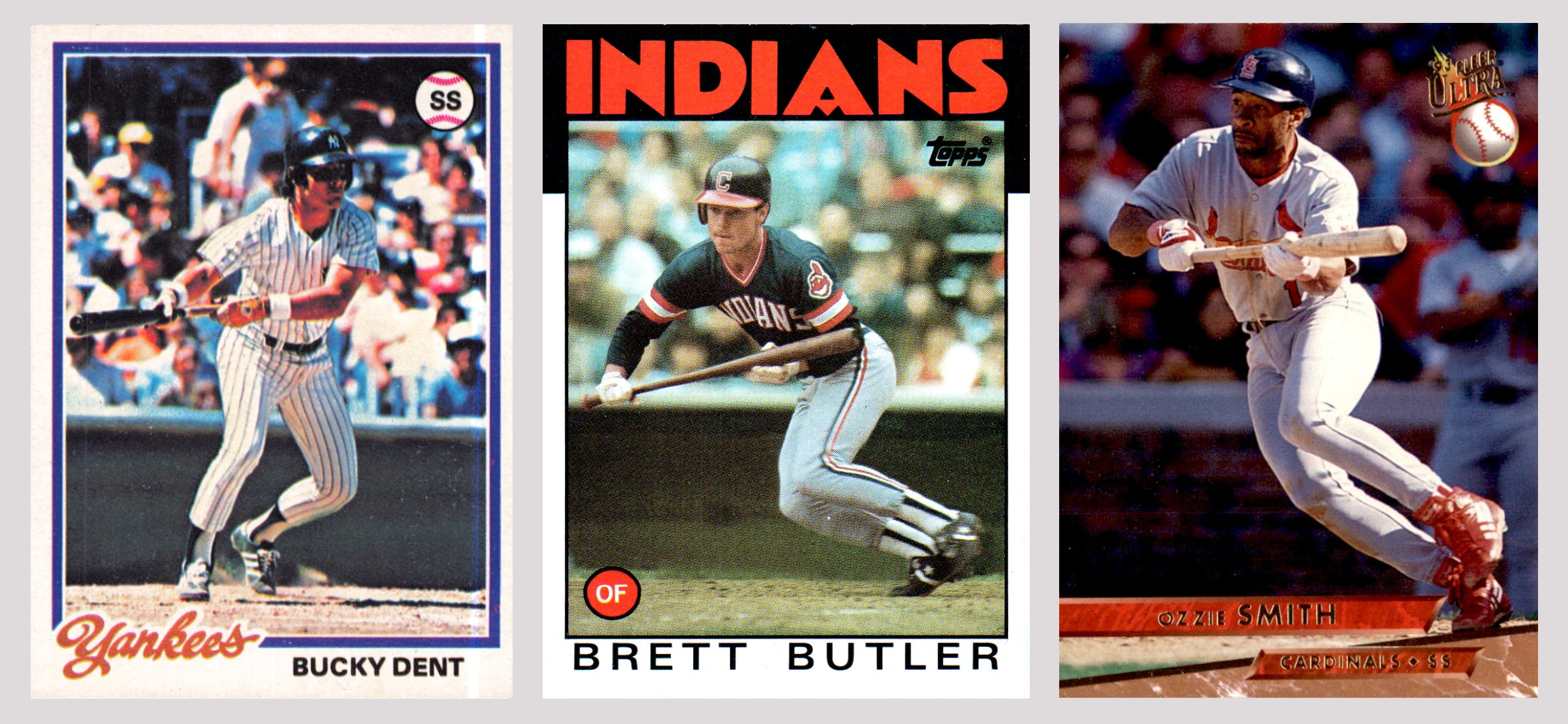
Bunting used to be a much, much bigger part of the game of baseball. I know. Weird to think about, right? But it's true. Back then, you'd even see plenty of examples on trading cards.


Bucky Dent: 121 career sacrifice bunts, led A.L. in 1974 with 23.

Brett Butler: 147 career sacrifice bunts, led majors in 1992 with 24.

Ozzie Smith: 214 career sacrifice bunts, led majors in 1978 with 28 and again in 1980 with 23.

 
It's quite a skill. And to lead your league (or the majors) in sacrifice bunts is quite an achievement. So you'd pretty much expect to see guys like Bucky, Brett, and Ozzie pulling it off on cardboard. 
 
But what about the sluggers? The RBI guys? The home run guys? 
 
Even if you can't imagine a big hitter squaring around and laying down a sacrifice bunt at a pivotal point of the game, there's plenty of evidence on trading cards to show that at one time in history, they did.
 
Here are 10 cardboard examples that might surprise you, listed in order of the player's slugging percentage. I'll also list some other numbers, including career sacrifice bunts.


1982 Donruss #510, Robin Yount

Robin Yount
.430 SLG%
251 HR
1,406 RBI
104 career sac bunts


1986 Donruss #180, Harold Baines

Harold Baines
.465 SLG%
384 HR
1,628 RBI
9 career sac bunts


1989 Donruss #208, Bo Jackson

Bo Jackson
.474 SLG%
141 HR
415 RBI
2 career sac bunts


1986 Donruss Pop-Up #NNO,
Dave Winfield

 Dave Winfield
.475 SLG%
465 HR
1,833 RBI
19 career sac bunts


1989 Fleer Baseball All-Stars #32, Kirby Puckett

Kirby Puckett
.477 SLG%
207 HR
1,085 RBI
23 career sac bunts


1981 Topps #720, Fred Lynn

 Fred Lynn
.484 SLG%
306 HR
1,111 RBI
25 career sac bunts


1991 Topps Stadium Club #95, Gary Sheffield

Gary Sheffield
.514 SLG%
509 HR
1,676 RBI
9 career sac bunts


1992 Donruss #286, Edgar Martinez

Edgar Martinez
.515 SLG%
309 HR
1,261 RBI
10 career sac bunts


1991 Fleer #136, Sammy Sosa

 Sammy Sosa
.534 SLG%
609 HR
1,667 RBI
17 career sac bunts


1992 Leaf #350, Albert Belle
 
Albert Belle
.564 SLG%
381 HR
1,239 RBI
4 career sac bunts

 
The notion that Albert Belle stepped into the batter's box, looked at the third base coach, received the sign for a bunt, and actually agreed to lay one down even once in his career is hard to believe. But it happened. And there's a baseball card to prove it!
 
A couple of other things stood out to me while I was doing research for this post:

(1) Robin Yount was a heck of an all-around player.
 
(2) Kirby Puckett had a season-high 8 sacrifice bunts in 1991, a year the Twins took home the World Series Championship. Whatever it takes to get those wins, right?
 
 
So maybe that's how to get bunting back into the modern game. Get some big guys like Aaron Judge or Pete Alonso to lay down a couple of surprise bunt singles, or a sacrifice bunt that leads to a comeback win.
 
Here's Juan Pierre to show them how it's done:


What do you readers think about the bunt? Do we need more of it in baseball?
 
And which slugger in the list above were you the most surprised to see bunting on a baseball card?
 
Share in the comment section, and thanks for reading!
Sunday, August 6, 2023

New Custom Card Set: 1980s Film Trios

It's summertime.
 
School is out, blockbuster movies are in. And during the 1980s, the decade of my childhood, there sure were some absolute classics, starring some legendary actors. 
 
Well, at some point this past year my nostalgia for these films began to mix with my creative itch to design. I started thinking about the best way to capture some of these folks—and some of the films they starred in—on custom cards. As I was going over a big list in my mind, I discovered that there were quite a few films that specifically featured a trio of big actors, all sharing the starring roles to some degree. Those film trios, as you might be thinking already, make a perfect match with a three-player rookie card. (And there are plenty of card designs to choose from there.) So with a little more thought and analysis, I narrowed down the pool to six great options, and one great card design. 

Here's a look at all six cards in the set.


(1) I thought for sure that The Karate Kid would have hit the #1 weekly rank at the box office at some point during its theater run in 1984. However, it only made it as high as #3. If you're wondering how that's possible, just look at this list of other films that were in theaters that year: Ghostbusters, Indiana Jones and the Temple of Doom, Gremlins, Beverly Hills Cop, and The Terminator. That's a heck of a lot of star power to contend with. But that year of big films aside, The Karate Kid did have the highest total box office gross of the 6 cards featured in this set. Crane kick for the win.


(2) Trading Places finished as high as #2 in the weekly film rankings for 1983, outdone only by Return of the Jedi. Akroyd, Curtis, and Murphy were all fantastic in this film, as were most of the other characters. If you haven't seen this one yet, I highly recommend adding it to your watch list.


(3) This was the first card I thought about when getting ideas together for the set. Talk about legendary trios. Ferris, Cameron, and Sloane are hard to beat. I'm surprised the film didn't earn a little more at the box office in 1986, but all the thrills and depth from James Cameron's Aliens, Oliver Stone's Platoon, and Stand by Me—an adaptation of a Stephen King novella—probably stole some of Bueller's comedy thunder that year. Still, this 6-card set just wouldn't be a set without Bueller and company.


(4) For a card set that features great film trios of the 1980s, Ned, Dusty, and Lucky were a natural fit. This is the one movie in the set that was released for the Christmas season instead of the summer. Must have been an absolute hoot to see this in theaters back then.


(5) Weird Science isn't one of my all-time favorite films from the '80s, but it's a total classic, featuring huge 1980s starlet Kelly LeBrock, plus Anthony Michael Hall, who was on an incredible run of films like National Lampoon's Vacation, Sixteen Candles, and The Breakfast Club.


(6) To round out the 6-card set, we've got a trio starring in what I consider a vastly underrated film of the decade. Before his more serious roles in films like Top Gun, The Doors, Tombstone, and The Saint, Mr. Kilmer showed off his comedy chops in Real Genius, and even earlier than that, in another wacky film called Top Secret! Just as with Trading Places, I highly recommend you add this film to your watch list if you've never seen it. Or even if you have.
 
And there's your 6-card set.
 
As for the card design, although it's from the 1970s (1972 to be specific), which doesn't match up with the 1980s release dates of the films in this set, I think it does feel perfect for film cards. That font running across the top of each card is called "Broadway". And the whole look on the card front resembles a movie theater marquee, or even a movie poster that you'd see outside the main entrance of a theater. So I think it works just fine. The different colors from the original 1972 set really help this special 6-card set stand out, too.

For the backs, I wanted to capture the unique look of each movie title, as well as add some "back-of-the-card" stats of some type. I went with Release Date, Running Time, Box Office Gross, No. of Theaters, and High Weekly Rank. They help tell the story of each film, while simultaneously helping to fill out the space toward the bottom of each card.
 
I will also say that I thought about representing some other film trios of the '80s. For example, there's Rocky, Adrian, and Mick from the Rocky films. And then there's Indiana Jones, Short Round, and Willie Scott from Temple of Doom. But trading cards already exist for those films, and in both of those cases the entire franchise wouldn't have been represented. I didn't want to have the name on the front of a card be something like "Rocky III" or "Indiana Jones and the Temple of Doom". It just seemed incomplete. So I stuck with a 6-card total.

So now it's time for you to share something in the comment section. Do you have a favorite film of the bunch? Have you seen all six of them? Is there another 1980s film trio that you would have liked to see included in the set?

Let me know, and thanks for reading!

Sunday, July 30, 2023

Babych Brothers

A couple of years ago, I added the Turgeon brothers to this "Siblings on Cards" series. One of the fascinating things I discovered about the Turgeons is that they're the highest drafted brother combination in NHL history. Sylvain was the 2nd overall pick of the Hartford Whalers in the 1983 NHL Entry Draft, while younger brother Pierre was the 1st overall pick by the Buffalo Sabres in the 1987 NHL Entry Draft.
 
But did you know that a few years earlier, another two brothers came awfully close to those numbers? Guess who they were.
 

Wayne Babych was drafted 3rd overall by the St. Louis Blues in the 1978 NHL Amateur Draft.
 
Dave Babych was drafted 2nd overall by the Winnipeg Jets in the 1980 NHL Entry Draft.
 
 
Yeah. I would never have guessed that, either. In fact, although I was familiar with the name Dave Babych, I can't say that his brother Wayne Babych was anything other than a name on a hockey card that I might have glanced at while flipping through 1980s commons here and there.
 
Let's right that wrong, first with some cards.


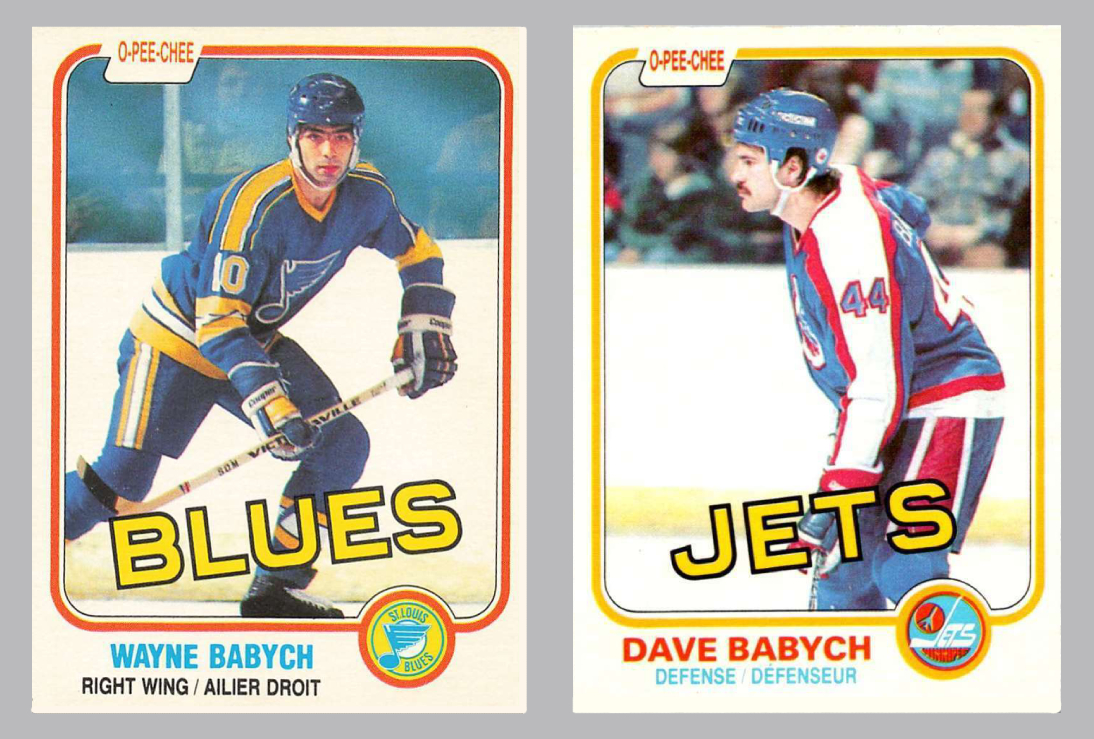
1981-82 O-Pee-Chee #290 Wayne Babych and #358 Dave Babych


Wayne and Dave are looking good there, and why not? Both brothers were having standout seasons around that time.

Let's first talk a little more about right winger Wayne. Baseball was his favorite sport growing up, and he must have been a very solid player, because along with the pro hockey offers he received, there were also five Major League Baseball teams interested in his services. Five! 
 
Wayne chose pro hockey, though, and it was a pretty good decision. As a teenager, he was selected to play for team Canada in the 1978 U20 World Championship. The following year he represented his country with the big boys in the 1979 World Championship. That was also his first season in the NHL, and he made folks take notice, finishing third in Calder voting (rookie of the year) behind winner Bobby Smith and second-place finisher Ryan Walter.
 
In his best NHL season, 1980-81, Wayne received some Selke trophy votes (awarded to the best defensive forward). He also represented the Campbell Conference in the All-Star game that year, recording 1 goal. (No wonder, as he'd finish the season with 54!) Across his career, Wayne suited up for St. Louis, Pittsburgh, Quebec, and Hartford. To this day, he, Brett Hull, and Brendan Shanahan are the only Blues players to have recorded 50 goals in a season.
 
As for little brother and defenseman Dave, he had much longer career. He also represented Team Canada like older brother Wayne, but in the 1981 and 1989 World Championships. His solid play throughout the early '80s earned him an All-Star appearance in both 1983 and 1984, and guess what? He matched his brother's All-Star feat, scoring a goal in each game! A couple of years later he even received some Norris trophy consideration (awarded to the best defenseman). However, it's difficult to win that trophy with guys like Ray Bourque, Paul Coffey, and Rod Langway around. Across his career Dave played for Winnipeg, Hartford, Vancouver, Philadelphia, and Los Angeles, and was a fan favorite wherever he went.

 
Let's look at some specific numbers now.


CAREER TOTALS


WAYNE

(9 seasons)

DAVE
(19 seasons)

GAMES PLAYED

519

1195

GOALS

192

142

ASSISTS

246

581

POINTS

438

723

PENALTY MINUTES

500

970

GAME-WINNING GOALS

20

20


BEST INDIVIDUAL SEASON
(Career highs in bold)


WAYNE

(1980-81, St. Louis)

DAVE
(1981-82, Winnipeg)

GAMES PLAYED

78

79

GOALS

54

19

ASSISTS

42

49

POINTS

96

68

PENALTY MINUTES

93

92

POWER-PLAY GOALS

12

11

GAME-WINNING GOALS

7

2


All bold numbers for Wayne there. Talk about a season for the ages!
 
Interestingly, both brothers played for the WHL's Portland Winter Hawks for a couple of years as teenagers, and they were on the same squad in 1977-78. (Dave was 16 years old and played 6 games; Wayne was 19, about to head to the NHL, and played 68 games). Both brothers also played together for the Whalers for a brief period in 1985-86. Dave was traded from Winnipeg to Hartford in November of 1985. Two months later, Wayne was traded from Quebec to Hartford. I'm sure they've got a few stories from that time.
 
So let's give some well-deserved recognition to the Babych brothers. Two impressive careers, and I'm happy to have learned a bit more about both players.

Sunday, July 23, 2023

What if There Actually Were a Hall of Very Good?

Well, it's Hall of Fame induction weekend in Cooperstown—the time of year when discussions about the greats of baseball are everywhere. Who should be in the Hall, but isn't yet? Who's in the Hall, but maybe shouldn't be? Who's right on the edge, but probably won't make it in?
 
Folks often place those players who are outside of the bubble in the fictitious "Hall of Very Good". It's a nice way of saying that a player had a tremendous career, while also acknowledging that they weren't quite the best of the best.
 
But what if there actually were a Hall of Very Good? 
 
Don't think it could happen? Well, we live in a ridiculous era of participation trophies. If the pendulum swings a little farther in that ridiculous direction, who's to say that a committee won't eventually be assembled to lobby for the creation of an actual Hall of Very Good?

And while we're at it, why don't we also drop it down another notch and create a Hall of Good? 
 
And a step below that, a Hall of Not So Bad? 
 
And then a step below that, a Hall of Eh, That Guy Wasn't So Good, but He Played in the Majors, So There's That?
 
Below you'll find descriptions of each of these make-believe Halls, along with potential building locations and a few of my selections for enshrinement. Read through the descriptions, and feel free to add some of the players you'd choose for each Hall in the comment section at the end of the post.
 
 
Hall of Very Good
Site: Lake Tahoe, California 


Guys who make it into the Hall of Very Good were really, really talented ballplayers. Northern California gives them a fitting place to chill out and bask in their excellence. Depending on your perspective on the matter, there could be at least 50 or so players in this hall, so we'd give them a nice, intimate building with some big windows so they can take in the view of the lake. Because a few of them might eventually make the trip across the country to Cooperstown, they'll be given a digital plaque that can be used to create a physical version in the future. Players can also contribute a couple of personal items, like a game-used bat or jersey that hasn't already been cut up to use on relic cards. 
 
Potential Candidates: Dave Parker, Don Mattingly, Keith Hernandez.


Hall of Good
Site: Dubois, Wyoming 


These guys were super-talented as well, just maybe a step below the Hall of Very Good. They've likely put up a bunch of hits, home runs, and RBIs. If not the power numbers, then they were notable in other ways. Perhaps they made a few All-Star teams, accumulated some Gold Gloves or Silver Sluggers, or were known to be near the top of the league in certain offensive or defensive categories for a season or two. Postseason heroics might also get you in here. (e.g., Kirk Gibson in '84 and '88) And because there are probably a few hundred players who'd qualify for this Hall, they get a big, sprawling ranch in Wyoming to kick back and enjoy the mountain scenery. Plenty of extra acres would be reserved for new ranches to be added to the complex as more players are inducted. Each inductee will be represented by a replica jersey and a glossy color photo.  
 
Potential Candidates: George Foster, Darrell Evans, Shawn Green.


Hall of Not So Bad
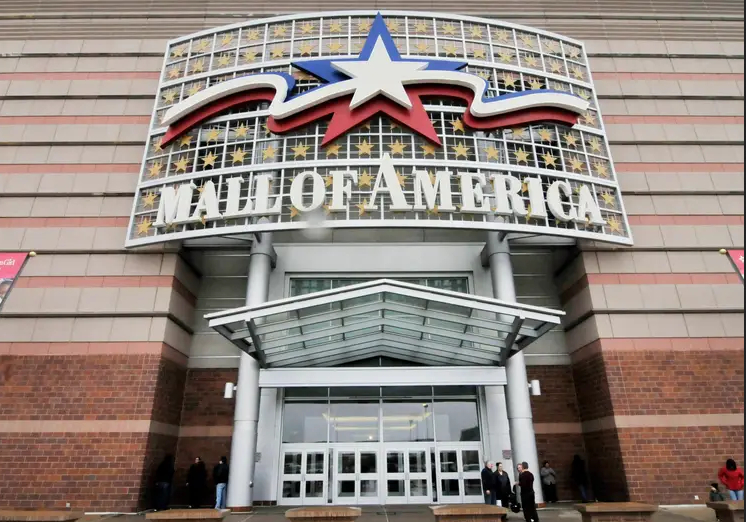
Site: Mall of America, Minnesota


There are thousands of players who fit this bill, so we're going to need some space. And with baseball being the national pastime, what better place to be than the Mall of America? A representative employed by Major League Baseball will rent out a storefront with lots of shelving space, and each inductee will have a small binder placed on one of those shelves—in alphabetical order by last name for easy fan access—which contains some of their baseball cards. Fans pay a simple $5.00 timed admission fee, and have 30 minutes to flip through the binders. Proceeds go toward rent and utilities for the mall storefront, and to the cost of purchasing binders and 9-pocket pages for new inductees. 
 
Potential Candidates: Spike Owen, Leon Durham, Candy Maldonado.


Hall of Eh, That Guy Wasn't So Good, but He Played in the Majors, So There's That
Site: Storage facility in Hoboken, New Jersey


I mean, it's sort of close to Cooperstown. Got to throw these guys a bone of some kind, right? 
 
There's got to be more than 10,000 players who fit this category, so each inductee will be represented by his final MLB card in a top loader so you can see his career stats. (If the player did not receive an MLB trading card during his career, a printout from baseball-reference.com will be provided in a separate binder.) The card will be stored in a monster box with all the other player cards, again in alphabetical order. Each player will be required to pay a $1.00 annual fee to help cover the cost of the storage unit plus administration fees.
 
Potential Candidates: Ross Jones, Brick Smith, Erik Johnson

So there you have it. A place to commemorate every player who's ever reached the majors.
 
Who are some players you'd vote into each Hall? I look forward to your answers.

 
__________________
 
Postscript
I'm sure all of you baseball enthusiasts and collectors out there understand that this blog post was satire. However, if the wrong folks read this, and if they're consequently inspired to create an actual Hall of Very Good one day—or any of the other Halls—I just want you to know that I accept full responsibility and will take all the blame you'd like to pile on.