Sunday, December 19, 2021

Join the NHL, See North America

Okay, the title of this blog post doesn't exactly represent the first "perk" that would cross the minds of most young, future pro hockey players. But it is a perk, isn't it?
 
There are many beautiful places across the United States and Canada, and professional hockey players, with all the road games they play throughout each season, can certainly tell you a thing or two about numerous cities north, south, east, and west.
 
However, as true as that might be, all of these players have a home team. And a home city. That means they only stay in each road city for a day or so before moving on to the next one, or heading back home for a few games.

But what about the rare players who've really experienced North America? The guys who've not only played in various cities, but also lived in them throughout their careers while playing for different teams? 
 
Well, one man stands on top of that hill. It's Mike Sillinger. 


This remarkable guy suited up for 12 teams across his 17-year NHL career. As of this writing, no other player in league history has reached even 11 teams, and only a small handful of players have reached 10. (If you're wondering where Jaromir Jagr falls on the list, he topped out at 9.)
 
Considering the logistics involved—finding a new home, selling your old one, moving your belongings and family, packing and unpacking your cold-weather or warm-weather clothing, learning the local roads, getting accustomed to your new teammates and media personalities—it's quite a remarkable accomplishment.
 
And all those stresses aside, the guy still had to try to bring his best game to the rink every night.

So let's have a look at Mike Sillinger's complete journey through the league, via trading cards and some stats. (Thanks to the internet for the cards shown in this post.)


1991-92 Upper Deck #457

All aboard: Detroit
1990-91 through 1994-95
129 GP, 14 G, 45 A, 59 PTS, 28 PIM 
(.46 points per game average)


1995-96 Upper Deck #72

 Next stop: Anaheim
1994-95 through 1995-96
77 GP, 15 G, 26 A, 41 PTS, 38 PIM 
(.53 points per game average)


1997-98 Collector's Choice #260

Next stop: Vancouver
1995-96 through 1997-98
138 GP, 28 G, 32 A, 60 PTS, 65 PIM 
(.43 points per game average)


1998-99 Pacific #331
 
Next stop: Philadelphia
1997-98 through 1998-99
52 GP, 11 G, 14 A 25 PTS, 24 PIM 
(.48 points per game average)


1999-00 Pacific Omega #219
 
Next stop: Tampa Bay
1998-99 through 1999-00
121 GP, 27 G, 27 A, 54 PTS, 114 PIM 
(.45 points per game average)


2000-01 Upper Deck Vintage #159

 Next stop: Florida
1999-00 through 2000-01
68 GP, 17 G, 25 A, 42 PTS, 60 PIM 
(.62 points per game average)


2001-02 O-Pee-Chee #194

Next stop: Ottawa
2000-01
13 GP, 3 G, 4 A, 7 PTS, 4 PIM 
(.54 points per game average)


2001-02 Upper Deck #282
 
Next stop: Columbus
2001-02 through 2002-03
155 GP, 38 G, 48 A, 86 PTS, 106 PIM 
(.55 points per game average)


2003-04 Upper Deck #398
 
Next stop: Phoenix
2003-04
60 GP, 8 G, 6 A, 14 PTS, 54 PIM 
(.23 points per game average)


2005-06 Upper Deck Artifacts #86
 
Next stop: St. Louis
2003-04 through 2005-06
64 GP, 27 G, 24 A, 51 PTS, 63 PIM 
(.80 points per game average)
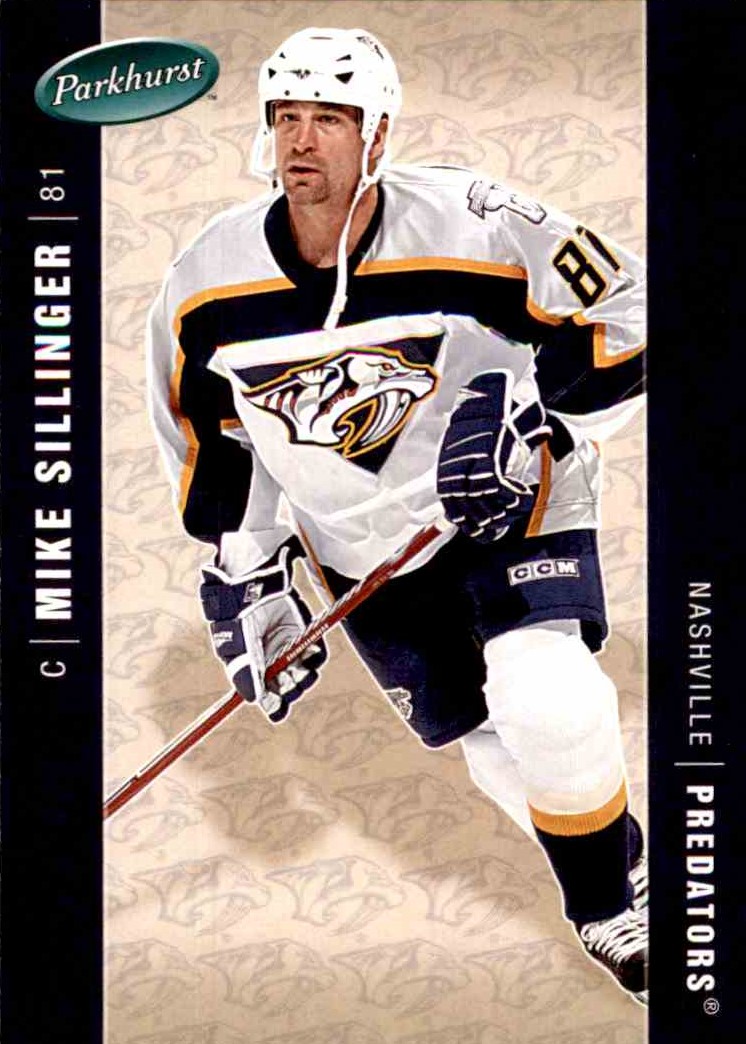


2005-06 Parkhurst #272
 
Next stop: Nashville
2005-06
31 GP, 10 G, 12 A, 22 PTS, 14 PIM 
(.71 points per game average)


2006-07 Upper Deck Victory #259
 
Last stop: Long Island
2006-07 through 2008-09
141 GP, 42 G, 45 A, 87 PTS, 74 PIM 
(.62 points per game average)


And for those of you who enjoy a good visual, here are Sillinger's career stops on a map:


But now scroll back up to the stats for a moment, and notice the points-per-game breakdown per team. You'll see just how consistent Mr. Sillinger was throughout his career, despite the different teams, offensive and defensive systems, and line mates. It goes without saying that the guy was bright, had a great work ethic, and perhaps an even greater determination to succeed. 
 
Here are some other interesting facts and figures:
 
  • Mr. Sillinger played in 1,049 games over his career, tallied 240 goals and 308 assists for 548 points, and accumulated 644 penalty minutes.
  • He put up 24 career shorthanded goals, which is top-50 all time as of this writing.
  • He had a very high face-off win percentage throughout his career, never dipping below 55% for a season and going as high as 63.26%.
  • His best individual season was 2005-06. Between the Blues and Predators, Sillinger played 79 games and put up 32 goals and 31 assists for 63 points, along with 63 penalty minutes, a shorthanded goal, and two game-winning goals.
  • He wore 10 different jersey numbers across his NHL career: 7, 21, 15, 23, 12, 26, 11, 18, 16, and 81.
  • The most seasons he played for any team was four, with Detroit. 
  • His son Cole was a first-round draft pick of the Columbus Blue Jackets (12th overall) this past summer. The team has already signed him to a three-year, entry level contract. Cole's brothers, Owen and Lukas, currently play for the Bemidji State University hockey team in the NCAA.
 
So here's to Mike Sillinger. What a terrific career across 12 North American cities. 
 
And if you ever need some good recommendations for restaurants, hotels, or attractions in any of them, you know who to ask.
 

Sunday, December 12, 2021

The 1982-83 O-Pee-Chee Dating Game (Episode 21)


Welcome back to The 1982-83 O-Pee-Chee Dating Game, where we'll randomly select three eligible bachelors from the set and you, the reader, will choose which one wins that date with a special lady. How do we know they're bachelors? Why, it says so right on the back of their hockey cards, that's how!

Previous episodes are available here.

The big winner of episode 20 was Grant Fuhr.

Now, let's start the 21st round and introduce the bachelors chosen by the randomizer! [APPLAUSE]
 
Bachelor number 1: Left wing from the Buffalo Sabres, Tony McKegney
Bachelor number 2: Center
from the Washington Capitals, Bobby Carpenter
Bachelor number 3: Defenseman
from the Montreal Canadiens, Gaston Gingras


Three hockey dudes just hangin' around on their cards. At least Gaston looks like he's getting ready for a face-off.

Let's find out more about them from the back of their cards.


I think once Bobby the computer nerd started geeking out about his Commodore 64, Tony and Gaston decided to tune out, and didn't share any hobbies.

Nevertheless, we've got to pick a winner for a date with our lovely lady this week. Who will it be?

Bachelor number 1: Tony McKegney, who's been putting up some solid numbers in Buffalo.

Bachelor number 2: Bobby Carpenter and his computers.

Bachelor number 3: Gaston Gingras, who could easily pass for a lumberjack in the forests of Témiscamingue, Québec, with that name and that mustache.

Sunday, December 5, 2021

2021 Series Custom Cards: PRINTED (Plus a Giveaway)

 
Fun news from Nine Pockets Headquarters:


The 2021 custom cards have arrived!

I finished the year with a total of 16 unique custom cards, not including the 1980-81 Topps hockey scratch-offs. If you do include those, it brings the total to almost 30. That means I put out more customs this year than ever. (22 designs in 2020, 9 designs in 2019.) I feel good about that.

Here's a closer look at a card front and a card back:


For continuity, I used the same template that was used for the 2019 and 2020 card backs, changing just the ink color to distinguish this year from the others. In 2019, the ink on the back was a dark gray. In 2020 it was indigo blue. This year, it's maroon.

The new cards are available for sale on my bonanza store and eBay store, but just as I did with the release of the 2019s and 2020s, I'd like to get some of these 2021s into the hands of you fellow collectors, free of charge. So let's do a giveaway for the first 15 commenters.


Here's what to do:

(1) Go to my custom card gallery and find three cards you'd like from the 2021 list. The only options currently unavailable are the Samurai Jack menko and the 1980-81 Topps hockey scratch-offs. (The scratch-offs pose a rather complex printing challenge that I haven't tackled to this point, but might try to tackle at some point in the future.)
 
(2) Come back here and leave a comment that includes your three card choices, plus one consolation choice just in case every single commenter wants the same three cards and I start running out of stock.
 
(3) If you haven't sent me your mailing address during a previous giveaway, or if your address has changed recently, please email me with that information. A link to my email address appears on my blogger profile page. You can also contact me on TCDB.
 
And that's all you have to do. 
 
Thanks so much to all you readers, fellow collectors, and fellow bloggers for spending some time here at Nine Pockets. You guys continue to provide great inspiration and entertainment, and I look forward to getting these custom cards out to you.

Sunday, November 28, 2021

How Kids Can Benefit from Collecting Cards

 
I have a nephew who recently turned eight years old. Back when he was about five, I gave him a stack of junk wax–era trading cards, just to see if the action would generate any interest. He wasn't a big sports guy back then, but he did find a few "shiny" baseball and hockey cards that he liked, along with some superhero cards that he quickly snatched up. 
 
That constituted enough interest for me, so I took out the small binder and some nine-pocket pages that I'd previously set aside and placed them in front of my nephew, explaining how they'd help keep the cards safe and organized. Watching the little guy take to them with eagerness and begin to slide cards inside each pocket made me a happy uncle.

Couple that early interest with a resurgence in the popularity of Pokémon cards among he and his classmates that school year, and soon I'd be bringing more binders, pages, and top-loaders with me whenever I visited.

On each of those visits, I was really impressed with the level of care my nephew took with his cards, whether they featured Pokémon, dinosaurs, sports stars, or whatever else.
 
Regardless, it got me thinking: Collecting cards can be of great benefit to kids.
 
Here are some examples.


Sorting
Kids can learn to sort cards by number, team, player/character, alphabetically, or as my nephew sometimes does it, by shiny cards and non-shiny cards.

Organization
Provide them with a few supplies, and kids will quickly figure out that they can use separate binders and boxes for separate projects.

Memory
Most of you reading this can probably describe a few of your favorite cards right off the top of your head: the colors, the design, exactly what the player is doing in the image, maybe even the blurb or the cartoon on the back. And I'm sure some of those cards go all the way back to your childhood.
 
Reaching Goals
Creating a to-do list and crossing items off that list is a great thing to teach youngsters, whether the list involves cards or not.

Seeing a Project Through to Completion
This relates to the previous example. How many of you remember how you felt when you completed your first full set of trading cards? How determined did you need to be to find those last few cards?

Taking Care of One's Belongings
Some kids take better care of their cards than others. But storing cards in pages, top loaders, and card-friendly boxes instead of just all over the place can teach a child a lot, and help them enjoy their collection.

Fair Dealings
I don't think my nephew has made any trades with his classmates yet, but ensuring a trade is agreeable on both ends is important, and I'll try to make sure he doesn't learn that lesson the hard way.


Quite a list!

And when that kid collector reaches adulthood, I think you can see how all of these skills will apply to "real world" situations as well.

I know I'm preaching to the choir here. But if you've ever bought cards for your nieces and nephews, or grandkids, or any kid, and the parents respond by giving you the "oh great, now there will be cards all over my house and I'm going to have to buy even more of them" look, just rattle off some of the benefits listed above and maybe those parents will change their tune.
 
What other benefits can come from collecting cards? Share in the comment section, and thanks for reading!

Sunday, November 21, 2021

I Didn't Beat the Streak (But Here's a Giveaway Regardless)

During this past baseball season, I played a fun online game offered by MLB.com called Beat the Streak.


To participate, you simply need to look at all the games being played on the current day’s schedule and select one player you think will hit safely in his game. If he gets a hit, your streak is at 1. For the next day’s schedule you repeat the process, hopefully extending your hit streak to 2.
 
The goal is to string together a streak of 57 hits with the players you choose, which would, in a virtual sense, surpass the legendary 56-game hitting streak that Joe DiMaggio established in 1941. It would also unlock your grand prize of 5.6 million dollars. Wow.

There's also a "double down" feature that allows you to choose two players per day, if you're feeling spunky.
 
In the 20 years since the game's inception, no one has beaten the streak. Back in 2012, one player managed to take his streak all the way up to 51 games. Then in 2015, another player hit 51. But that's as close as anyone has come. Usually, pushing your streak
even as far as 25 or 30 games is considered exceptional, and would likely rank you in the top 100 out of tens of thousands of participants. (This year there were more than 100,000 registered participants.)
 
And that's what makes the game so perplexing. With all the players to choose from and all the data available on hitters and pitchers, you’d think you’d be able to find at least one or two “locks” every day. But if you know baseball, you know it doesn't exactly work that way.
A hot hitter can belt a line drive in the gap that's caught by a diving outfielder, while a guy who's gone hitless in his last 15 at-bats will send a blooper off the trademark that somehow carries just enough to fall between the second baseman, first baseman, and right fielder for a base hit. I’ll share one example from my past season.


Here’s outfielder Raimel Tapia. Before June 23, 2021, I didn’t know anything about him. But on that day, I logged in to my Beat the Streak account and discovered he was riding an 18-game hitting streak, was batting over .300, and his team was facing a cold pitcher whose ERA was close to 6.00. So I selected him as my hitter.
 
And what did Mr. Tapia do in his five trips to the plate?
 
1. Ground-out to second baseman (0-for-1)
2. Ground-out to third baseman (0-for-2)
3. Walk

4. Ground-out to third baseman (0-for-3)
5. Ground-out to third baseman (0-for-4)
 
So just like that, Tapia's hitting streak was over, and I was back to zero.
 
It’s still a fun game, though. And for me, a person who doesn’t collect modern cards or follow teams around the Majors too closely, Beat the Streak provides an opportunity to learn about some of the game’s talented young hitters, like Raimel Tapia and these next few guys, who I ended up picking rather often throughout the season. (Thanks to the Internet for providing the images.)


Across his past three MLB seasons, Tim Anderson has batted well over .300. In fact, he led the league with a .335 batting average in 2019. The talented infielder scores a lot of runs from the top of the lineup, and will put up about 15 or 20 stolen bases per season, too. Let's have more stolen bases in baseball, please.


Trout and Ohtani receive most of the attention in Anaheim, and rightly so. But David Fletcher wields an impressive bat, too. He'll collect more than 150 hits per season, and over this past summer he ran a hit streak all the way up to 26 games. Toward the end of the season he really cooled off, though.


Adam Frazier had quite a hot start to the 2021 season, putting up more than 100 hits by the halfway point and making the N.L. All-Star team. He was traded to San Diego in July and his hitting slowed down through August, but he really picked it back up in September, batting .325 for the month.


Cedric Mullins really broke out in 2021, making the A.L. All-Star team. He hung around the top few spots on the hit leaderboard for most of the season, and put up a solid amount of doubles and home runs. Quite a few stolen bases, too.
 
 
Back to the game now. What makes it that much more fun is that even if your streak doesn’t get anywhere close to 57 games (mine topped out at 18), MLB still provides you with a prize of some kind every time your streak reaches 5-game intervals. The prizes aren’t much, but include things like a 15% discount at MLBShop.com, a free week-long subscription to MLB.tv, or one entry into a contest that offers a trip to the World Series as the grand prize.
 
And there’s another prize that sometimes appears: A code you can enter on the Topps BUNT website to redeem a special pack of Beat The Streak digital baseball cards. I won five of these codes throughout the season.
 
I don’t collect modern cards, and it thereby follows that I’m not exactly interested in collecting virtual versions of modern cards, so I’m going to offer my Topps BUNT codes as a little giveaway here. Just be one of the first five people to say something like “I WANT A CODE!” in the comment section below, and I’ll email a code to you. (One per person, please. Codes expire on 12/31/21.)

 
It's yet another little way of thanking all of you for spending some time here at Nine Pockets.
 
If you're one of the claimants and I don't already have your email address, here's how to reach me:
 
My email address is available on my blogger profile page

You can also message me on TCDB.
 
 
So, have any of you played Beat the Streak? If you have, what’s your longest hit streak? Maybe next baseball season we’ll get a little competition going among bloggers.
 
I look forward to your comments!

Sunday, November 14, 2021

This Custom Card Might Call You a Sucker MC

Last year I created a Beastie Boys custom card using the 1982 Topps "Future Stars" design. It's been a big hit, and recently I thought about another world-class trio of the era that would look terrific on the 1982 template.


It's Run-DMC!

Chronologically, it's perfect. McDaniels, Mizell, and Simmons first teamed up around 1982, officially founded Run-DMC in 1983, and released their first album in 1984.

As for the design elements, similar to the Beastie Boys card, I used baseball-themed backgrounds from a few of the original 1982 Topps cards. I also inserted the stage names DMC, Jam Master Jay, and Run where the fielding positions would normally appear.

And this trio was an absolute sensation. How much so? I can illustrate by sharing an experience that two of my elementary school friends and I had back around '86 or '87—particularly a friend named David:
 
It was summer vacation, and we'd been playing at a nearby field. Dusk was quickly approaching, which meant it was time for us to get home. We all lived within a few houses of each other, and only had one more block to walk when a bigger kid stopped us. (In retrospect, he was probably only in middle school or high school, but when you're 8 or 9 years old, that translates to huge and intimidating.)

Big Intimidating Kid: What are you doing?
David: Going home.
Big Intimidating Kid: You live around here?
David: Yes.
Big Intimidating Kid: You ever hear of Run-DMC?
David: Yeah. Those are my initials. 
Big Intimidating Kid: What do you mean?
David: My initials are D-M-C (Proceeds to say his first, middle, and last name out loud.)
Big Intimidating Kid: Ah man, now we're friends. (Holds out hand, gives David a low-five.)
 
And then he went his way and we went ours. Home in time for dinner, a confrontation dispelled by the power of music.
 
But don't just take my word for it. Watch this video and then tell me you didn't get into it, or at least smile once or twice.


One thing about the group I appreciate is that their lyrics, by and large, were not raunchy, explicit, or violent. It was much more about rhyming, dominance, skill, and fun. Listen to a song like Peter Piper or You Be Illin' for more examples.
 
Also of note, in 1986 Run-DMC partnered with Aerosmith to create a new version of the rock band's 1975 hit Walk This Way. The crossover helped introduce countless rock fans to rap, and vice versa. (Watch the music video for more guaranteed entertainment.)


BONUS CARD

It's one thing to have the members of Run-DMC on a Future Stars card, but the 1982 Topps set has a perfect "In Action" template that I wanted to use as well.


Can't get much better than an image showing the three guys doing their thing at an outdoor concert.

So that's that. Another two custom cards in the books. Any Run-DMC fans out there? Favorite song? Share in the comment section, and thanks for reading!

                                         ---------------------------------------------------

PS: Things will get pretty busy at work for the rest of the calendar year, which means these Run-DMC customs will be the final two custom cards for the 2021 series. I've placed a print order for all the 2021 customs, and once they arrive I'll hold another giveaway like I did for the 2019s and 2020s. Stay tuned for that!
 
PPS: Speaking of giveaways, come back next Sunday for a chance to take part in a smaller one.

Sunday, November 7, 2021

Niedermayer Brothers

If you grew up playing sports with a sibling, I'd bet at least one of these fantasy scenarios will sound familiar:

1. Your sibling has the basketball near the top of the key. He's double-teamed and passes you the ball in the corner with seconds remaining on the clock. You plant your feet, square your shoulders, and take the shot. Three... two... one... swish! You've won the championship.

2. Your sibling walks up to the line of scrimmage behind the center. You line up wide, knowing a long "Hail Mary" pass is the only play that'll work. The ball is snapped. You sprint toward the end zone while your sibling drops back, waits, and then heaves the football. Looking up, you track its flight, and diving across the goal line, you make the grab. Touchdown! You've won the championship.

3. You stand on the mound, wiping sweat off your brow. There are two outs in the bottom of the ninth inning, and you need one more strike. Your sibling crouches behind the plate and gives you the sign you're looking for: Fastball, high and inside. He opens his mitt and provides the target. You wind up, uncoil, and let the pitch go. There's no way the batter can catch up to it. Strike three! You've won the championship.

4. You and your sibling skate across the offensive blue line on a two-on-one. The game is tied with seconds to go. As you reach the slot, your sibling slides the puck under the stick of the lunging defenseman and right toward you. Your one-timer speeds past the outstretched leg pad of the goaltender and into the back of the net. Goal! You've won the championship.

So much excitement. So many recreated triumphs. 
 
That last scenario in particular must have been played out thousands of times by a young Scott and Rob Niedermayer on the ponds of British Columbia. But it didn't stop there.

Scott, the older brother by about a year and a half, exhibited enough talent in his teenage years to be taken in the first round (third overall) by the New Jersey Devils in the 1991 NHL Entry Draft. Just two years later, in the 1993 Draft, young Rob was also selected in the first round (fifth overall). He'd go straight to Florida and sign a contract with the Panthers. Neither brother played a single minor league game before stepping onto NHL ice.

Here are both Niedermayers, looking quite sharp on vintage-inspired cardboard.
 

1994-95 Parkhurst Vintage #V22 Rob Niedermayer and SE Vintage #seV12 Scott Niedermayer


Scott and Rob both had early success with their respective teams, and as the years went on, Scott would really rack up the accolades in New Jersey. An All-Rookie Team award, three Stanley Cups, and numerous All-Star selections. Rob was no slouch either, playing solid two-way hockey at center and at times earning quite a good amount of Selke Trophy consideration (awarded "to the forward who best excels in the defensive aspects of the game.") 
 
Scott continued on and on in New Jersey, while Rob was part of a couple of trades—first to Calgary in 2001, and next to Anaheim in 2003. Then something interesting happened.

In 2005, after 13 seasons with New Jersey, Scott signed as a free agent with that same Anaheim team.

The brothers had been reunited. And with the whole team taking shape (Teemu Selanne, Chris Pronger, and a young Ryan Getzlaf and Corey Perry), it wouldn't take long before the Niedermayers would recreate some of those childhood hockey fantasies.

The 2006-07 version of the team finished first in the Pacific Division, and rolled through the first two rounds of the playoffs, defeating Minnesota and then Vancouver, losing just one game against each.

Then, in Game 2 of the Conference finals against Detroit, this happened:


Not quite a game-winning goal in Game 7 of the Finals, but still pretty special for the Niedermayers. A few days later, Scott assisted on Rob's empty-net goal to wrap up Game 4.

And that wasn't all, of course. After the Ducks took down Detroit, they went on to the Stanley Cup Final and took down Ottawa, four games to one. Scott, the captain of the team, was awarded the Conn Smythe trophy as playoff MVP. After that, he was given the Stanley Cup to hoist. After his turn with the Cup was finished, who do you think he handed it over to?

That's right, younger brother Rob. What a great moment.
 
Here are some numbers for both brothers:


CAREER TOTALS


SCOTT

(18 seasons)

ROB
(17 seasons)

GAMES PLAYED

1263

1153

GOALS

172

186

ASSISTS

568

283

POINTS

740

469

PENALTY MINUTES

784

904

GAME-WINNING GOALS

39

29


BEST INDIVIDUAL SEASON
(Career highs in bold)


SCOTT

(2006–07, Anaheim)

ROB
(1995-96, Florida)

GAMES PLAYED

79

82

GOALS

15

26

ASSISTS

54

35

POINTS

69

61

PENALTY MINUTES

86

107

POWER-PLAY GOALS

9

11

GAME-WINNING GOALS

3

6


Rob was a little on the chippy side, as you can see by his 904 penalty minutes in 1,153 games. He was a very smart player though, capable on both the penalty kill and the power play. He suited up for Florida, Calgary, Anaheim, New Jersey, and Buffalo across his 17 NHL seasons.
 
In that 2006-07 Stanley Cup playoff run with Anaheim, he posted 5 goals and 5 assists for 10 points, and added a league-leading 39 penalty minutes. For his career, in 116 playoff games he totaled 18 goals, 25 assists, 43 points, and 111 penalty minutes. (4 power-play goals and 3 shorthanded.)
 
Also notable is that Rob earned two gold medals with Team Canada: At the 1993 World Junior Championships and the 2004 World Championships.
 
As for Scott, he played in a remarkable 202 playoff games across his career, which puts him in the top 25 all time as of this writing. In those games he scored 25 goals and added 73 assists for 98 points. He was a plus-20 overall, and scored 12 of those 25 goals on the power play and 3 of them shorthanded—as a defenseman!

In the 2002-03 Stanley Cup playoffs with New Jersey, he led the league in assists (16) and tied for the lead in points (18). He suited up for the Devils and Anaheim across his 18-season career.
 
One more interesting fact on Scott: He's a member of the "Triple Gold" club, having won the Stanley Cup, plus a World Championship title (2004, with brother Rob) and the Olympic gold medal (2002, 2010) with Canada. For good measure, he was also part of a World Junior Championship team (1991), a Memorial Cup–winning team (1991-92), and a World Cup of Hockey championship-winning team (2004). Corey Perry is the only other player to have won all six of those titles. 
 
So here's to the Niedermayer brothers. Two great careers, and some childhood fantasies played out for real on the highest stage.