This
Perma-Graphic credit card arrived in the mail
recently (front and back shown). It was originally issued by Topps in 1981, but it's still good
today.
The cards are printed on plastic of a similar thickness to any other valid credit card. Similar length and width, too. And just as with many other brands, they're available in a variety of designs. I went with Keith Hernandez here, who'd soon win the first of his two World Series Championships. By this point he'd already won three Gold Glove awards and taken home a share of the 1979 MVP award. Pretty good player to represent your credit rating, don't you think?
As for the full list of designs on
offer, there are 32 in all, with many of the big names you'd expect.
The first five cards will give you an idea: Bench, Schmidt, Brett,
Yastrzemski, Rose. And if that's not enough, there's this (in fine print at the bottom of the card):
AS A COLLECTOR OF THE LIMITED EDITION SUPER STAR CREDIT CARD SERIES YOU ARE RECOGNIZED AS A LOYAL BASEBALL FAN AND A MEMBER IN GOOD STANDING OF THE ELITE SUPER STAR FAN CLUB.
Surely your local department store manager will recognize that you—in good standing of the elite super star fan club—can charge items throughout the store with no limit.
Why not pick one up for yourself today? (Note: I am an unpaid spokesperson)
About a year ago I discovered the coolness of vintage Japanese baseball cards, also known as menko. Soon after, I added the first few to my collection. But since then I haven't added any more. In fact, I've hardly purchased trading cards of any kind. Well, that changed recently when I had the opportunity to pick up a sizeable stack of menko. Not baseball menko, mind you, but something that'll be nostalgic for most 1980s kids like me:
Transformers!
There were 36 unique menko in the package: 16 Autobots, 2 combination cards, and 18 Decepticons. Quite a few duplicates as well.
I have to admit that for a little while I had buyer's remorse. Why did I need so many of them? I would have been more than happy with just a few, for a little nostalgia. The other side of the coin, however, is that I don't think I've ever seen these menko come up on auction sites before. And I've already found one blogger who can use some of the duplicates (they're in the mail, SumoMenkoMan).
So enough with the rationalizing already. For many of you collectors out there, buying a few dozen cards is probably known as "a weekday". Let's get to the cards.
First, the Autobots.
Couldn't start with anyone other than Optimus Prime, autobot leader (Semi Truck). The grid lines in the background alone indicate that this card is from the 1980s. (1985, to be exact.)
A nice group of Autobot vehicles came with the stack. From left to right: Bumblebee (Volkswagen Beetle), Hound (Military Jeep), Wheeljack (Race Car), and Prowl (Police Car).
Next we've got Red Alert (Lamborghini), Trailbreaker (Camper Truck), Inferno (Fire Truck), and Sideswipe (Lamborghini). The colors on all of these menko are still impressively vibrant.
Also included were all five Dinobots: Grimlock (T-Rex), Slag (Triceratops), Sludge (Brontosaurus), Swoop (Pterodactyl), and Snarl (Stegosaurus). Kids love dinosaurs, kids love Transformers. Good marketing decision by someone at Takara/Hasbrothere.
Here are Blaster (Cassette Player) and Perceptor (Microscope).
And two combo cards (Optimus Prime/Scrapper, Megatron/Perceptor). Each card measures approximately 1.75 inches wide by 3 inches tall.They're pretty thick, too—I'd say almost three times as thick as a standard 1980s baseball card.
Here are a couple of card backs, one Autobot and one Decepticon. On the bottom you'll see that kids could have used these cards for a rock-paper-scissors game, as well as a game that simulated some sort of dice throw.
Now let's get to the Decepticons.
Two of the fighter jets were included (Starscream on the left, Skywarp on the right). As far as names of evil robot fighter jets are concerned, I don't think you can get much better than Starscream and Skywarp.
Impressively, the stack of cards also included the complete Construction group. From left to right, we have: Hook (Crane), Long Haul (Dump Truck), Bonecrusher (Bulldozer), Mixmaster (Cement Mixer), Scrapper (Front-End Loader), and Scavenger (Power Shovel).
And when all six of those neon-green machines assembled together, they created this guy, named Devastator. Seems like it would be tricky for a robot to maneuver with a front-end loader as one foot and a cement mixer as the other, but by gosh Devastator did it.
Here are all three Insecticons. From left to right: Shrapnel (Stag Beetle), Kickback (Grasshopper), and Bombshell (Boll Weavil).
Next we've got Frenzy and Rumble (Audio Cassettes). I always liked these guys, because in the original cartoon they spoke with a slight "tough guy from Brooklyn" accent. Just watch and listen to this short clip, as Rumble gets fooled by some Autobots.
"I must have static in my rectifiers", he says.
Here are another two audio cassettes, Laserbeak and Ravage. I think Ravage may have been the first Transformer I owned way back then. My dad bought it for me one night from a vendor on a Manhattan sidewalk as we were walking back to the apartment.
And why are there so many audio cassettes, you ask?
This guy! Soundwave, the cassette player and recorder. He'd send the cassettes out to gather intelligence. Then they'd return, transform into their cassette mode, and Soundwave would play back the information they gathered.
Finally, there's Reflector, with a cameo on the lower left by Shockwave. I didn't know much about Reflector, but in my research I discovered that three smaller Decepticons (Spectro, Spyglass, and Viewfinder) would join together to create him. He's a camera in his other form.
These menko will always provide a great little trip down memory lane for me, and I can imagine they've done the same for a few of you folks who grew up around the same time.
Did you have a favorite Transformer back then? Own any of the toys? Share in the comment section, and thanks for reading, as always.
Back in 1988, the grade school version of me was busy playing Little League baseball, collecting baseball cards, and loving it. However, I'd also made a new friend at school who played hockey. (As did all of his brothers. I think there were six of them.) Soon I'd start learning more about this new sport, playing it, and by association, opening packs of hockey cards for the first time.
Because of all this, the 1988-89 Topps hockey set brings back a lot of fun memories for me. I'd open those first packs and immediately get hit by the players, the uniforms and logos, and the kid-friendly design.
Just look at the cards. Everything is fun, colorful, and fitting for the decade. The slanted color bar with the pushpin holding it in place will remind any '80s kid of bulletin boards. The dotted pattern underneath is reminiscent of halftone comic book printing. Even the colors themselves are fun, with greens, magentas, yellows, and blues that I wouldn't hesitate to describe as neon. (Or is it Day-Glo?) Beyond the design, though, this set of cards also helped teach me about the game. Here's how.
I'd already learned that playing
hockey took a lot of physical effort. But the 1988-89 set showed me what to do if I got tired: Wait for the whistle to stop play, lean your stick across your shin pads, and catch your breath before the next face-off.
After a few seconds went by, the referee would skate into that face-off circle and prepare to drop the puck. Then I learned how important it was to get into your
solid, stable, ready for action face-off stance.
Why?
Because once that puck dropped, you had to move like these next six guys.
Watch John MacLean hustle to avoid a hook from an Edmonton player. Dan Quinn is swooping in, looking for a potential rebound. And Dave Archibald might have just dished off a backhand pass while weaving through some Boston defenders. (Good job keeping your head up, Dave!)
Ron Sutter carries the puck across the red line with speed, alert and looking to make a play. Mats Naslund scoots down the wing, ready to receive a pass. And Wayne Presley sets up at the side of the net, preparing to deflect a shot or jam home a rebound.
Truth
be told, though, this set of cards contains too many images of players
leaning their sticks across their shin pads or lining up for a face-off.
The six action cards you've just seen are few and far between.
Even the goalies did their share of standing around, look.
Regardless, it was all good information for a kid who'd just become enamored with the sport. And besides, along with giving me those hockey tips, the set also introduced me to some talented rookies like the three guys above (and the first guy below).
It also showed me just how
momentous of an occasion it was when Wayne Gretzky was traded to Los
Angeles. (And just how pink a checklist
card could be.)
Here's an example of a card back.
Note that every card features the game-winning goals box underneath the player stats. (Stephane Richer had the most,
with 11). Goalies also had a box on their cards, which listed their shots against totals instead. Grant Fuhr had
the most, with 2,066 shots against in a whopping 75 games played.
And
finally, just as
exciting as the cards were the stickers. They came one per pack,
and featured a player who was named to either the first or second
all-star team or, even more awesome, a team sticker that included block
numbers and sometimes three little hockey puck decals.
Here's the reverse:
Back then, if you actually followed the instructions on the card and put one of those hockey puck stickers on your helmet each time you scored a goal or an assist, you'd probably get beat up and have your helmet thrown over the fence.
Ah, the memories.
Thanks for flipping through some 1988-89 Topps hockey cards with me. The set really is a fun one, and despite the shortage of action shots you'll still find some nice-looking cards and a huge number of Hall of Famers. At a manageable 198 total cards, it's not a daunting task to complete it—even less daunting if you've already got some of the key players like Gretzky, Hull, Shanahan, and Turgeon. Now who wants to play Blades of Steel on the NES?
As I finished putting together the Wolverine/Thor1974 all-star custom card last year, I had a thought: That template could produce an almost endless amount of combinations. Right then and there I jotted down some potential ideas and set them aside for another time. It's been quite a while, but I've been on a creative streak lately, so I decided to sit down and get to it. Since the original card was from the 1970s, I thought it would only be fitting if I kept the content in that decade(or close to it). For this batch, I'm also staying with the entertainment theme.
First up, another two superheroes. This time they represent TV shows.
Wonder Woman aired from 1975 to 1979, while The Incredible Hulk ran from 1978 to 1982. That means for at least two years (not including reruns) you could have probably watched both shows each week in prime time. Talk about cloud nine if you were a superhero-loving kid!
Next, another fun show where good guys foiled bad guys.
CHiPs aired from 1977 through 1983. I must have caught the very tail end of their run, because in my early days (i.e., bicycle with training wheels) I remember having a plastic CHiPs helmet, complete with a tinted plastic visor that you could flip down.
This next show is one I remember my mom watching.
Laverne & Shirley ran from 1976 to 1983. I'm not sure I've ever watched a full episode, but the opening theme that shows both characters at the brewery is so iconic that I wanted to make a card. Now here's a show where you might consider all of the characters to be all-stars. (Even though they're not human characters.)
The Muppet Show ran from 1976 through 1981, although reruns must have aired for years afterward because I definitely watched the show as a little tyke in the mid-1980s. I really could have chosen just about any character from the show—Kermit the Frog, Gonzo, Fozzie Bear, Animal, The Swedish Chef, the list goes on and on. But for this card I went with Beaker, skittish lab assistant to Bunsen Honeydew, and First Mate Piggy from the "Pigs in Space" series. (PIIIGS INNN SPAAAAACE!)
And talk about shows where all of the characters were all-stars...
Taxi ran from 1978 to 1983, and starred Judd Hirsch, Danny DeVito, Tony Danza, Andy Kaufman, Christopher Lloyd, Jeff Conaway, and Marilu Henner. Similar to the Muppets card, I could have made a great custom with any of these actors, but chose Marilu and Tony for this one. Great theme song, too.
Finally, on the subject of theme songs, here's a TV show that contains one of my favorite theme songs of all time.
The Odd Couple ran from 1970 to 1975. Have you ever thought about whether you were more of an "Oscar" or a "Felix"? They're both pretty far toward their respective ends of the spectrum, but if we're honest, we've all probably had some Oscar moments and some Felix moments in our lives.
One more note about theme songs: You'll see that I listed each show's title with a clickable link. Those links will take you to the respective theme songs/intros on YouTube. I encourage you to take a few minutes to watch them, because they're all such classics and they define the era so well. Here's one from The Odd Couple to whet your appetite:
I think I'll allow the backdrop of Manhattan skyscrapers and historic hi-rises in that closing scene to wrap up this post. Wow.
Welcome back to The 1982-83 O-Pee-Chee Dating Game, where
we'll randomly select three eligible bachelors from the set and you,
the reader, will choose which one wins that date with a special lady. How do we know they're bachelors? Why, it says so right on
the back of their hockey cards, that's how! Previous episodes are available here. The clear winner of episode 11 was Mark Pavelich.
Now let's start the 12th round and
introduce the bachelors chosen by the randomizer! [APPLAUSE]
Bachelor number 1: Center from the Boston Bruins, Barry Pederson Bachelor number 2: Left wing from the Detroit Red Wings, Paul Woods Bachelor number 3: Goalie from the New York Rangers, Ed Mio
Folks, I'm looking back through our episode list to confirm. . . and yes, we've got our first goaltender on the show! Give Eddie Mio another nice round of applause, please. [APPLAUSE] Now, let's learn more about all three of our bachelors from the back of their cards.
Who intrigues you the most, studio audience? Bachelor number 1: Golfer and former Victoria Cougar, Barry Pederson. Bachelor number 2: Landscaping business owner, Paul Woods. Bachelor number 3: Four-year college man, newly arrived in New York City from Edmonton, Ed Mio.
Today's entry has some Hall of Fame connections. The man on the original card is the son of a baseball Hall-of-Famer. The man on the custom card is a well-known rock & roll Hall-of-Famer. Here's the original:
1959 Topps #384, Dave Sisler
Now add some long brown hair and distinct American rock vocals. Any idea who the look-alike is? Here are some hints:
If he were an umpire, after calling ball four he might point to first base and tell the batter to Walk this Way. If he were a pitcher who threw a no-hitter, he might say the victory filled him with Sweet Emotion. Instead of baseball cards in the attic, he might say he's got Toys in the Attic. Enough hints? Okay, here's the custom:
The eyeglasses are not Steven Tyler originals. I borrowed a pair from Dave Sisler to complete the look. Details for the rest of the card: I listed Mr. Tyler's position as "vocals-harmonica" with a hyphen, which helps give a wink back to some of the original 1959 cards that listed multiple fielding positions. The team name switched from Red Sox to Aerosmith, of course, and I swapped out the Red Sox mascot for an Aerosmith logo, color and outline to match. I also found an example of Mr. Tyler's autograph online and added it in place of Mr. Sisler's.
Speaking of Mr. Sisler, he had a pretty good pitching career
across seven years and four teams. (Pretty bright guy too, going to
Princeton on an academic scholarship while playing on the baseball and basketball teams.) Career numbers as a starter and reliever?
38-44, 4.33 ERA, 12 CG, 1 SHO, 28 SV, 355 SO
And his Hall-of-Fame father? None other than George Sisler. As for Steven Tyler and Aerosmith, what can I say? I was a big fan back in my pre-teen and teenage days. In fact, Permanent Vacation was the first album audio cassette I ever owned. Overall, I prefer the raw, hungry, 1970s version of Aerosmith above all other vintages. (Although the album Pump, released toward the tail end of 1989, was a really good one too.)
But even with all that said, I couldn't leave this custom card on its own. Why? Because you can't mention Steven Tyler without mentioning the other front man in the band, guitarist Joe Perry. And because the multi-player cards in the 1959 set provide a perfect template, it was only natural to create this card:
When you consider the alliteration that's present in some of those 1959 multi-player cards, such as Cubs' Clubbers, Keystone Combo, and Batter Bafflers, you'll see that "Toxic Twins" works just perfectly. And similar to the Kel Mitchell-Kenan Thompson combination cardI did a few months ago, I think I like this Toxic Twins custom even a little better than the Steven Tyler custom up top.
So that's that. Another fun project completed. And now I'm going to wrap it up with one of my favorite Aerosmith tunes, fittingly titled Combination:
Any Aerosmith fans out there? Favorite song? Favorite album? Share in the comment section.
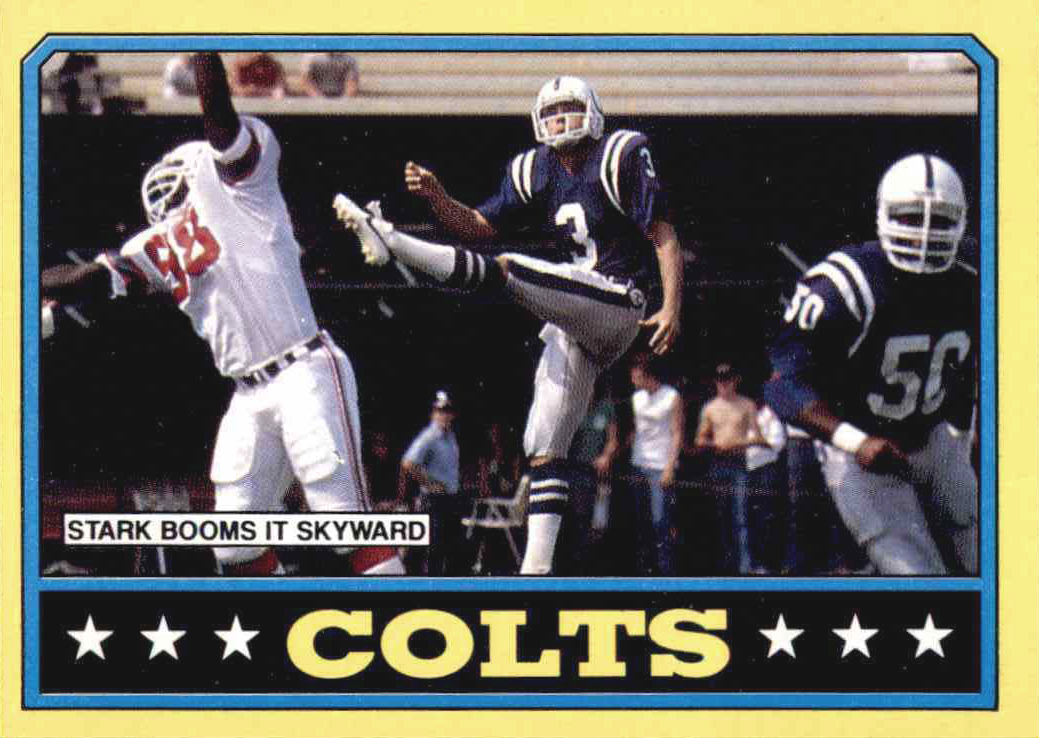
Consider the various examples of disorder and oddity.
(1) On the left, number 98 of the Patriots
has been spun around in the wrong direction, we can assume during an
attempt to reach up and deflect the punt. On the right, number 50 of the Colts is positioned
a little bit better, heading downfield, but not exactly in the direction of
the punt. The action resembles a scene from one of those vintage electronic football game tables where the figurines get vibrated all
over the place.
(2) What's up with the dudes standing off the field in the background? One of them, toward the right of the frame, is shirtless. Another, just left of center, might be a security figure of some kind with blue shirt and hand on hip. In front of said security figure appears to be a folding lawn chair. And it seems like only the thinnest strand of rope is separating them all from the field. (3) Look at the bleachers above the dudes. Aside from three fans hunched over on the left (and maybe a camera man?), the section is completely empty. And they're bleachers. Not individual seats. Seems odd for an NFL stadium. But among all the discombobulation, there's punter Rohn Stark. Captured in the moment. Exhibiting perfect form.
Look at his eyes. They're focused on the flight of the football. He wants to make sure he's struck it well and aimed it true. And if that beautiful picture doesn't tell you enough, the caption on the bottom left—black text framed in a bright white box—tells you all you need to know: STARK BOOMS IT SKYWARD You can almost hear the sound of his foot striking the ball, can't you? Look at that security figure in the background of the original card again. I think maybe he heard the sound too, and it was so sweet and pure and solid that he had to turn around and look. What a moment to capture on cardboard. And consider that life as a punter can't be easy. You're only called into the game for a few seconds at a time. And in those few seconds you've got to somehow catch the long snap and have absolute focus while 275-pound monsters are pushing ever closer toward you with the sole intent of stretching their arms out and smothering the ball as it leaves your foot. For this punt, it looks like Stark found those few seconds of clarity. It also seems like he found that clarity throughout his career. The four-time Pro Bowl member led the league in total punting yards in 1983 (4,124), and more impressively led the league in yards per punt in 1983 (45.3), 1985 (45.9), and 1986 (45.2). He finished second in 1982 and 1984.
And for one of those moments—pure clarity and concentration amidst such chaos—1986 Topps Football #314 has a place in my box of favorites.