Showing posts with label Dave Taylor. Show all posts

Sunday, January 17, 2021

1980-81 NHL Scoring: What Was in the Water? (Part I)

A little more than a year ago I wrote about a largely forgotten NHL record. During the 1980-81 season, the Triple Crown Line in Los Angeles did something quite special. Each player on that line—Marcel Dionne, Charlie Simmer, and Dave Taylor—finished the season with more than 100 points. And the folks at O-Pee-Chee commemorated the record with a card in the 1981-82 set.

That record-breaker card caught me by surprise, so much so that after writing about it I began looking deeper into the full set. Quickly I'd find the other record breaker cards. Have a look at the complete list:


#390: Hat tricks (Mike Bossy, 9)

 
#391: 100+ points by each member of a forward line
(Marcel Dionne, Charlie Simmer
, Dave Taylor)


#392: Points (Wayne Gretzky, 164)


#393: Points by a rookie defenseman (Larry Murphy, 76)


#394: Assists by a goalie (Mike Palmateer, 8)


#395: Points by a rookie (Peter Stastny, 109)


There was so much offense, even the goalies were putting up points! And if no player on your hometown team was setting league scoring records, you probably still watched a couple of your guys set personal scoring records. It's a trend that would continue throughout the decade. What a time to be a hockey fan.

But there's a peculiar side-note to all of this: Those record breaker cards go from #390 to #395, despite the fact that there are 396 cards in the set. So what's the final card? A checklist? A team card of the Stanley Cup champions?

No.

#396, the final card in the set, is . . .


Bob Manno.

Well that's odd. After a great run of record breaker cards, why not end the set with one more? Or push Manno back to card #390 and move all the other record breaker cards up one spot, so the set ended with the Stastny card? 

I started to wonder whether O-Pee-Chee, at some point in production, thought about creating another record breaker card but then scratched it for some reason.

After some digging in the stat books, I found two possibilities:

(1) Mike Bossy put up a whopping 28 power-play goals during the 1980-81 season. Up to that point in NHL history, it was the highest total ever (he broke the former record of 27, which had been reached most recently just two seasons earlier by . . . Mike Bossy).

(2) Charlie Simmer had a record-setting shooting percentage during the 1980-81 season, and the number is so high it will knock you right out of your chair. Get ready:

32.7%

Yes. That's correct. Charlie Simmer scored on more than 3 out of every 10 shots on goal he took that season. Practically 1 out of every 3. And he scored a total of 56 goals. It was the highest NHL single-season shooting percentage ever.

But Bossy (#390, hat tricks) and Simmer (#391, Triple Crown Line) already had record breaker cards in the set. Perhaps O-Pee-Chee began working up #396 for either Bossy or Simmer, but then thought that one record breaker card for each of them was enough.

And so Bob Manno got the spot. Airbrushed into an Maple Leafs jersey. Oy.

One more theory? Another record was tied that year, and it was a big one: Mike Bossy scored 50 goals in his team's first 50 games. Maurice Richard was the first to do it, 36 years earlier, and no one had done it since.

I suppose it's possible that O-Pee-Chee had thought about reserving spot #396 for a "highlight" card of some sort to celebrate the record-tying feat, but changed their minds. Or maybe, if production schedules called for the set's design to be completed before the end of the hockey season, they were hoping Bossy would score 50 goals in fewer than 50 games, flat-out beating the record and allowing for a final record-breaker card. Or, as mentioned earlier, it could have simply been a case of too much Bossy. He already had seven cards in the set:

#198 (Base Card)
#208 (Super Action)
#219 (Team Leader)
#382 (League Leader, Goals)
#386 (League Leader, Power-Play Goals)
#388 (League Leader, Game-Winning Goals)
#390 (Record Breaker, Hat Tricks)

Regardless, think about the onslaught of goals and assists and points and rookies . . . and goalies with eight assists of their own. What an exciting season 1980-81 must have been. And we can thank O-Pee-Chee for documenting much of that excitement on cardboard.

Stay tuned for part II, coming next week.

Sunday, November 17, 2019

Here's to Linemates

The record shown on this card escaped my knowledge for all this time:
 

1981-82 O-Pee-Chee Record Breakers #391

Details on the back:


I've got to admit, it surprised me.

I figured the first linemates to each score 100 points in a season would have been Bossy-Trottier-Gillies on Long Island, or Kurri-Gretzky-Anderson in Edmonton.

But no, it's the Triple Crown Line in Los Angeles! Here are their final numbers for the 1980-81 season:

Marcel Dionne: 135 points in 80 GP
Dave Taylor: 112 points in 72 GP
Charlie Simmer: 105 points in 65 GP

Pretty impressive, no?

As for those Islanders, the Trio Grande almost did hit the mark in 1978-79.


Bryan Trottier: 134 points in 76 GP
Mike Bossy: 126 points in 80 GP
Clark Gillies: 91 points in 75 GP

But that's as close as they'd get. Gillies was more of the rugged power-forward type, protecting the two stars on his line with physicality and fisticuffs. However, the guy could definitely score, too. I figured he would have tallied a 100-point season at some point during the high-flying '80s, but no.

And what about Kurri-Gretzky-Anderson? Well, that one is more complicated.


First, Kurri (75 points in 75 games) and Anderson (53 points in 58 games) were just rookies during that record-breaking season, so putting up 100 points each would have been a tough ask—even for a couple of kids boiling over with talent. Secondly, that trio of Kurri-Gretzky-Anderson wasn't exactly a trio as I thought. Gretzky and Kurri stuck together as a formidable center-wing pair, but it seems like they rotated through a few different wingers on the other side. Glenn Anderson was only one of them. So you can't really call those three a line.


With those great teammates out of the equation, how about some other notable lines that almost hit the mark?

In 1971-72, the GAG Line (goal-a-game) came ever so close for the Rangers.


Jean Ratelle: 109 points in 63 GP
Vic Hadfield: 106 points in 78 GP
Rod Gilbert: 97 points in 73 GP


In 1974-75, the French Connection Line in Buffalo came tantalizingly close as well.


René Robert: 100 points in 74 GP
Gilbert Perreault: 96 points in 68 GP
Rick Martin: 95 points in 68 GP

 
In 1975-76, the LCB Line in Philadelphia almost got there.


Bobby Clarke: 119 points in 76 GP
Bill Barber: 112 points in 80 GP
Reggie Leach: 91 points in 80 GP


The 1976-77 Dynasty Line in Montreal wasn't too far from it either, but Jacques Lemaire was more of a two-way center (who still managed a point per game, sheesh). 


Guy Lafleur: 136 points in 80 GP
Steve Shutt: 105 points in 80 GP
Jacques Lemaire: 75 points in 75 GP


And the Stastny Line came reasonably close in 1982-83 for the Nordiques. That would have been amazing.


Peter Stastny: 124 points in 75 GP
Anton Stastny: 92 points in 79 GP
Marian Stastny: 79 points in 60 GP

 
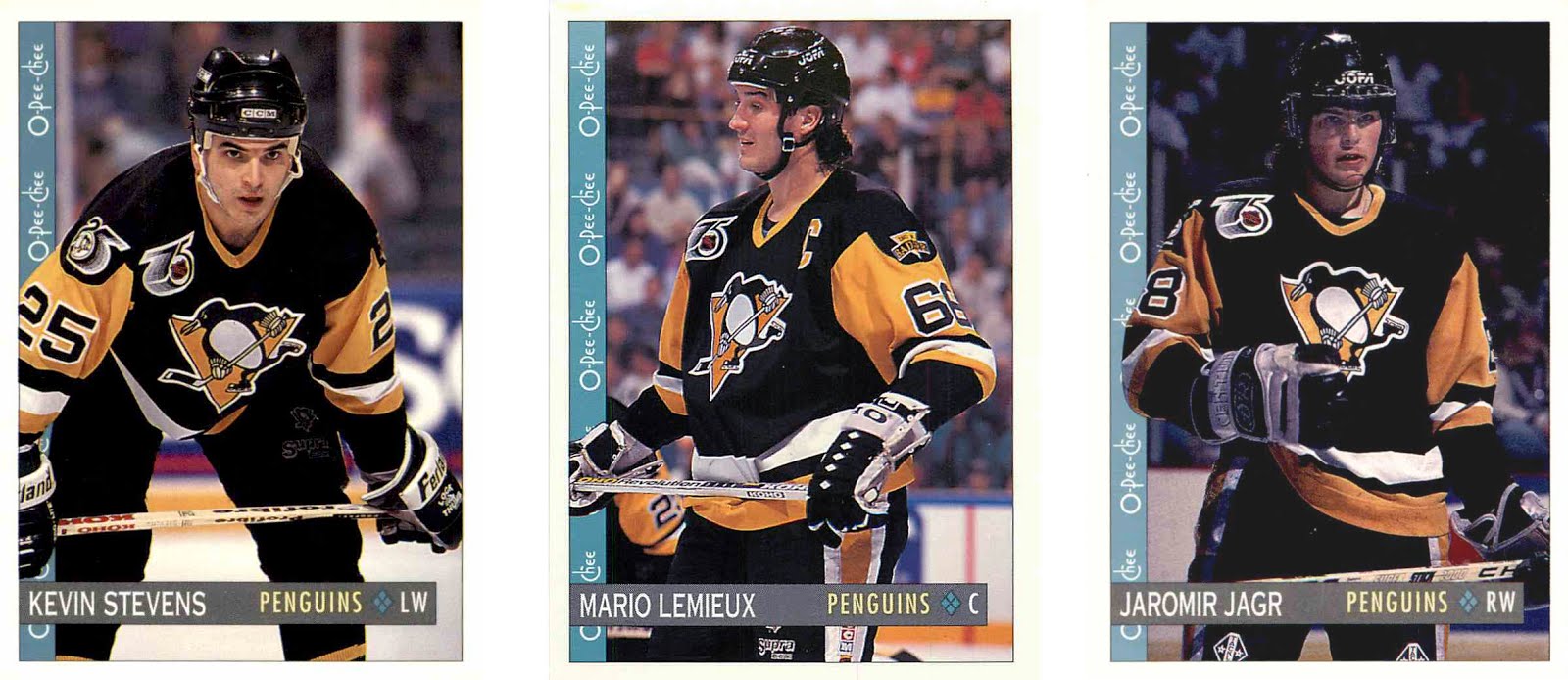
Then a decade later (1992-93) the Sky Line in Pittsburgh almost did it.


Mario Lemieux: 160 points in 60 GP
Kevin Stevens: 111 points in 72 GP
Jaromir Jagr: 94 points in 81 GP


Look at how many all-stars and hall-of-famers appear in those trios. It goes to show you just how tough the accomplishment is.

And it also provides a reminder: 

In today's game it would be very difficult for three forwards to set the mark as a unit—not only because of the line-juggling strategies that coaches seem to employ throughout the season, but also for the much more structured style of play across the league. Oh, and goalies all seem to be 6-foot-5 and 230 pounds with big, puffy pads and catching gloves as big as one of those novelty foam #1 finger-pointing things that sports fans wear at the stadium.

And here's something else we're reminded of: Because forward lines don't remain intact as long these days, the great line nicknames don't come around as much. Add these legendary nicknames to those mentioned above: The Kid Line in Toronto (Conacher-Jackson-Primeau), The Punch Line in Montreal (Lach-Blake-Richard), The Legion of Doom in Philadelphia (Lindros-Leclair-Renberg), The Russian Five in Detroit (Fedorov-Kozlov-Larionov-Konstantinov-Fetisov), the JAM line in Colorado (Sakic-Hejduk-Tanguay).

But who knows? It seems like offensive numbers have been up a little bit over the past couple of seasons, at least for some of the really big stars, and nothing remains constant in professional sports. Maybe we'll see this kind of milestone set again one day.

No matter how the game changes, though, the Triple Crown Line of Simmer-Dionne-Taylor did something remarkable that should not be overlooked. And when your team has a forward line that's just freewheeling it, game in and game out, you won't find much better entertainment.


Here's to linemates sticking together and having enough success to make a name for themselves.