Showing posts with label 1977-78 Topps. Show all posts

Sunday, April 10, 2022

Completed Set: 1977-78 Topps Glossy Hockey Inserts (rounded edges)

A couple of years ago, I finished the 1977-78 Topps Hockey base set. It was, and still is, the oldest hockey set I've completed. And although at the time I was aware of a small insert set that went along with the base set, I didn't pay it much attention. After all, I was still busy celebrating the main set completion. 
 
However, time has since gone by, and I've been looking for another set to complete. Not really up for a big set build, I've been going back to some of the sets I've already completed to see if there's anything else I can add to them. For example, wax box bottoms, instant win cards, stickers, and the like.
 
So, I looked into the glossy inserts for this '77-78 set. There are only 22 cards in total, which I thought was very doable. And back when these cards were available as wax packs in local drug stores and supermarkets and the like, one glossy came in each pack. I figured it would only be right to find all 22 and add them to the 1977-78 binder. 
 
With a combination of trades on TCDB and a few little purchases on sportlots.com, the set was complete. Here are all 22 cards, in number order.
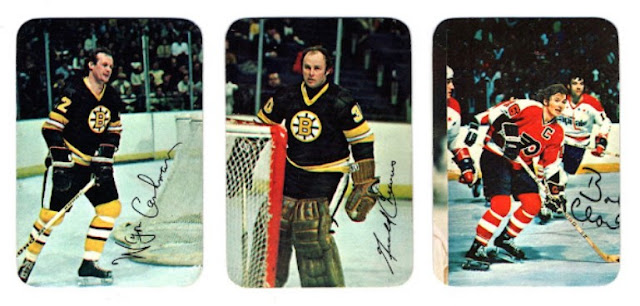


First up we have Wayne Cashman on the prowl behind the net, Gerry Cheevers sporting those classic leather pads, and a miscut Bobby Clarke. (Maybe I'll replace that one someday.)
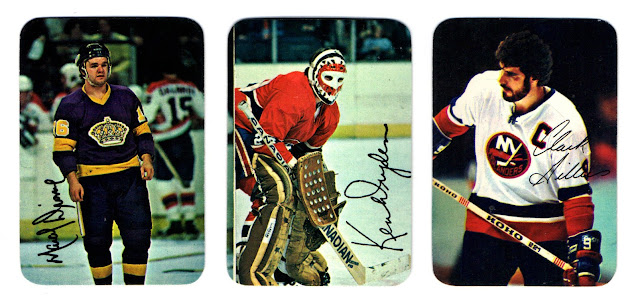


Next it's Marcel Dionne, who's possibly heading to the penalty box after a scrap, Ken Dryden with a super-cool, classic paint job on the mask, and Jethro (a.k.a. Clark Gillies) lookin' tough.
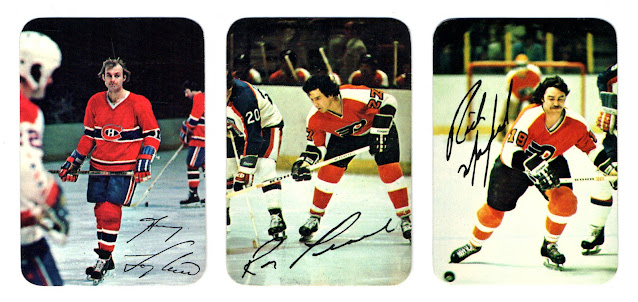


Guy Lafleur is captured in a moment of stillness, soon to be going 30 mph no doubt, Reggie Leach is giving a little stick chop to a Rangers player on the face-off, and Rick MacLeish is chasing after a loose puck. Looks like he's going to get there first.
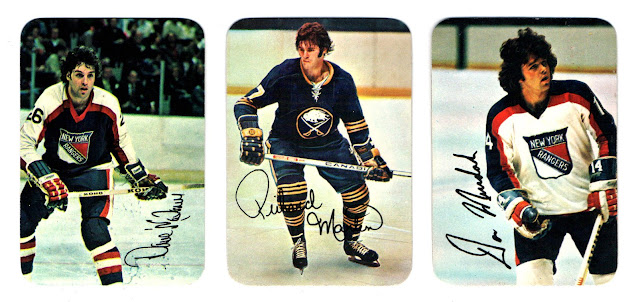


Now it's Dave Maloney playing some defense, Rick Martin on the offensive, and Don Murdoch with some nice hockey hair. It seems like most players made a deliberate effort to sign their names in whatever open white space existed on the photo, which is really nice.
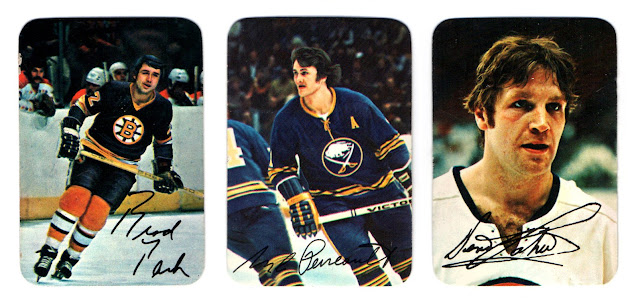


Here's Brad Park coasting around as some Captials look on from the bench, Gilbert Perreault showing us that classic Sabres logo, and Denis Potvin, who has likely either just thrown a body check, or is looking to throw one. If you've noticed by now that these cards go in alphabetical order by the player's last name, give yourself a bonus point.
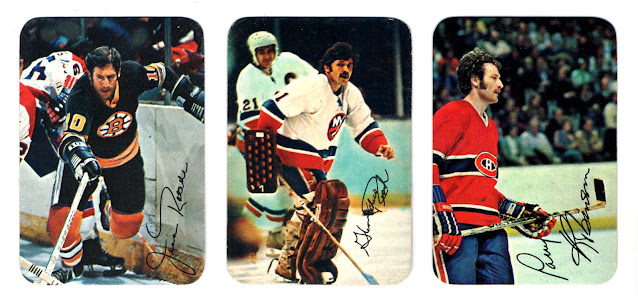


Next we have Jean Ratelle battling along the boards, Glenn Resch loosening up in pre-game warmups, and Larry Robinson skating into the frame to assess the scene in front of him. These cards measure 2 1/4 by 3 1/4, so they're a little smaller than standard. The cardstock is a little different too, and card fronts have a slight gloss. Another interesting point is that these cards were issued with square corners, too. (Same players, same order.) I'm not sure about the distribution rates, or if that was a regional thing, but the square-cornered versions appear to be more scarce.
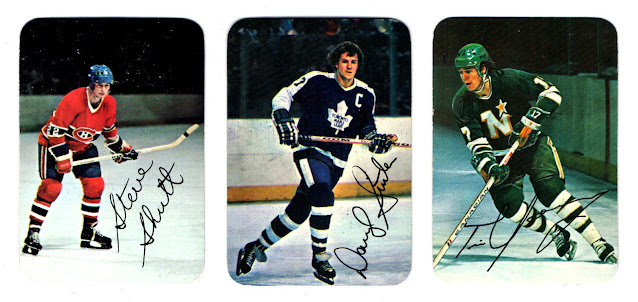


Steve Shutt positions himself for a one-timer while Darryl Sittler shows us his nimble crossover step. Meanwhile, Tim Young darts toward the goal from the left wing. Shutt had a monster year, with 60 goals. As for Tim Young, this was only his second season in the league, but he had a career year with 29 goals, 66 assists (T-3rd in NHL), and 95 points (T-5th in NHL).
 
I actually went slightly out of order with those three cards, however (19, 20, and 22), in order to leave card 21 on its own. 
 
Why?


It's a horizontal card! There's Rogie Vachon, ready to make a save. What a terrific photo.

Now here are some card backs.


Not much to talk about there. But there are some talking points about this set.

For instance, as I was putting it together, I wondered how the players were selected. Did they represent the all-star selections from the previous year? Well, most of the all-stars were included, but not all. Borje Salming and Guy Lapointe are missing.
 
So, how were the players chosen? I investigated a bit further:

The set consists of 13 players from the Wales Conference and 9 players from the Campbell Conference, so Topps didn't use that factor as a guide. 
 
The set consists of 4 goalies, 4 defensemen, 7 centers, 4 left wings, and 3 right wings, so Topps didn't quite use that factor as a guide, either.
 
There were 18 teams in the NHL at that time, and only 9 are represented in this insert set:

4 Boston Bruins
4 Montreal Canadiens
3 Philadelphia Flyers
3 New York Islanders
2 Los Angeles Kings
2 New York Rangers
2 Buffalo Sabres
1 Toronto Maple Leafs
1 Minnesota North Stars
 
Strike that factor from the equation, as well. 
 
So what is it? Well, the choices seem to be based on the points leaders from the previous season. But even so, Topps left out players that could have very well been included, like Lanny McDonald (5th in goals, T-8th in points), Borje Salming (T-3 in assists), Wilf Paiement (6th in goals), Peter McNab (T-8th in goals, T-11th in points), Phil Esposito (13th in goals, T-17th in points), and Butch Goring (T-10 in assists, 12th in points).

So why not swap in a few of those guys for Boston's Wayne Cashman, or the Rangers' Dave Maloney or Don Murdoch, who didn't show up near the top of the scoring leaderboards? It would have been fun to see the wider variety of uniforms that Wilf Paiement of the Rockies, Dennis Maruk of the Barons, or Guy Charron of the Capitals would have brought to the set, for example.
 
Regardless, it's still a nice little set, and I'm happy to have completed it and added it to my '77-78 binder.


And that leads to a question for you readers: 
 
When you complete a base set, do you then go for insert sets like this one? 
 
And if you already have the base set in a binder, do you add the insert set at the end? Or maybe the beginning? I add mine at the end of the binder.

Share in the comment section, and thanks for reading!

Sunday, November 29, 2020

Completed Set: 1977-78 Topps Hockey


The 1977-78 Topps hockey set arrived at an interesting point in time. 

The NHL was pretty entertaining throughout the decade. Leading goal scorers like Guy Lafleur, Phil Esposito, and Marcel Dionne were putting home 50 or 60 per season, and plenty of other veterans like Bobby Clarke, Gilbert Perreault, and Bobby Orr were easily breaking the 100-point mark. However, it was still B.G.E. (Before the Gretzky Era.)

What does that mean, exactly? Well first, scoring would increase even more in the 1980s, which must have made card collecting even more exciting for young kids of the era. Secondly, in 1979 the NHL would pluck four teams from the struggling World Hockey Association. Adding those teams meant more players on cards for collectors to collect. And third, some of the league's brightest stars like Orr, Mikita, and Cheevers were nearing the ends of their careers. They'd soon be replaced by new Canadian stars like
Bourque, Bossy, and Gretzky, as well as an influx of exciting players from Europe and the States.

All that being said, the 1977-78 set is a touch on the light side when it comes to star power, rookie cards, and financial burden. And that's precisely why I set out to make it my first completed hockey set of the '70s.

But let's get back to the stars. The first few cards of the set feature league leaders. 


Steve Shutt had a career year, hitting the 60-goal mark. His teammate Guy Lafleur hit 56, and Marcel Dionne put home 53, including the 200th of his absurd career total of 731. 

The next two cards feature the assist and point leaders, respectively, but what really catches the eye in this set is card number 4.


Penalty minute leaders?!?

Got to love that. And I suppose the existence of this card is an indication of the style of play back then, as well as what interested the fans. Bad dudes were on the ice and on cardboard.

If you're wondering about the totals, Dave Williams accumulated 338 penalty minutes, Dennis Polonich racked up 274, and Bob Gassoff finished at 254. Noted tough guy Dave Schultz finished just off the podium with 232.

And that penalty minutes card wasn't all. Have a look at the guys on these next few cards.


The Flyers (a.k.a. Broad Street Bullies) and Bruins (a.k.a. Big Bad Bruins) were two of the roughest teams of the '70s, as you can see here. On the left, Orest Kindrachuk has just finished trading haymakers with someone, and has the wounds to prove it. In the middle, Don Saleski and Garry Howatt are grappling, but both seem more interested in something off to the side there. And on the right, Wayne Cashman shows a poor Captials player a wrestling move he saw on TV last night. 

But wait, there's more!


Willi Plett cools off in the penalty box while Hartland Monahan looks for his other glove, likely after a scrap. (The teammate behind him is also gloveless, look.) And on the right, Rookie Dave Farrish listens respectfully to a referee's explanation of a penalty call. I like how teammate John Davidson is giving the ref a good stare-down, refusing to even remove his goalie mask. 

But the 1977-78 set wasn't all about the rough stuff, of course. There's a surprising amount of action captured on cardboard, too.


The Red Wings got their share of nice action shots. I'm impressed by the camera work and the low angles. The images above almost make it seem like you're right there on the ice, especially on that middle card. 


Same with the image of Bobby Schmautz on the left. Looks like you just passed him the puck. In the middle, Dave Forbes is about to cut toward the net from the left wing. He's doing a nice job keeping his head up and assessing his options. On the right, noted speedster Pat Hickey really wants the puck, and I don't think the Capitals player behind him is going to catch up.


Here, Pit Martin gives us a good look at the type of skates players were wearing in 1977. Dennis Kearns looks like he's digging toward the corner to throw a body check on a poor winger. And there's Andre Savard, fending off a hook from a Captials defender.

Next, an example of a card back.


The hockey stick on the left is a nice design element, and the player's name across the top really stands out. The card number is in a bit of an odd place, but you can find it alright. Underneath the stats you have some nice bullet points describing the player (when space allows). And finally, there's a cartoon at the very bottom of each card. Here are a few of my favorites.


The 1977-78 set featured team cards as well (they had checklists on the back). 


The North Stars went for a high-angle view, while the Flyers went more face-on, and had no problem showing off some recently won hardware. For those of you keeping tabs at home, the trophy on the left is the Conn Smythe Trophy, awarded to playoff MVP Bernie Parent in 1974 and 1975, and teammate Reggie Leach in 1976. The middle trophy is the Clarence S. Campbell Bowl, awarded to the Western Conference Playoff Champions. The Flyers won it from 1974 through 1977. And on the right you have the Hart Memorial Trophy, awarded to the NHL MVP. Bobby Clarke won it in 1973, 1975, and 1976.

On the subject of teams, this set includes cards from three teams that are now defunct.


Also now defunct, the glorious brown leather pads that goalies once wore. If you enjoy those "waffle board" blockers as much as I do, you'll enjoy this set.


And here are three legendary players who were almost at the end of their careers. 


Bobby Orr does look strange on a Black Hawks card. (Note how Topps airbrushed him into the Hawks jersey, but left his teammate in the background in his Bruins jersey.)

The set also features a few record-breaker cards, and adds a nice, bright banner to the tops of the all-stars, as you can see on Borje Salming's card in the middle. On the right, a pleasant color combination for the checklists.


The final three cards in the set briefly document the NHL's run to the Stanley Cup championship. It's a nice little wrap-up. I especially like that middle card. Those two Bruins teammates look like hungry wolves chasing down their prey.


And that's that.

Although this set is absent of the big studs of the 1980s, and although the design is largely borrowed from 1977 Topps baseball, there's still some good merit to be earned. It's one of those sets that a collector can warm up to as they're putting it together. I'm happy I've completed it.

Thanks for reading, as always.